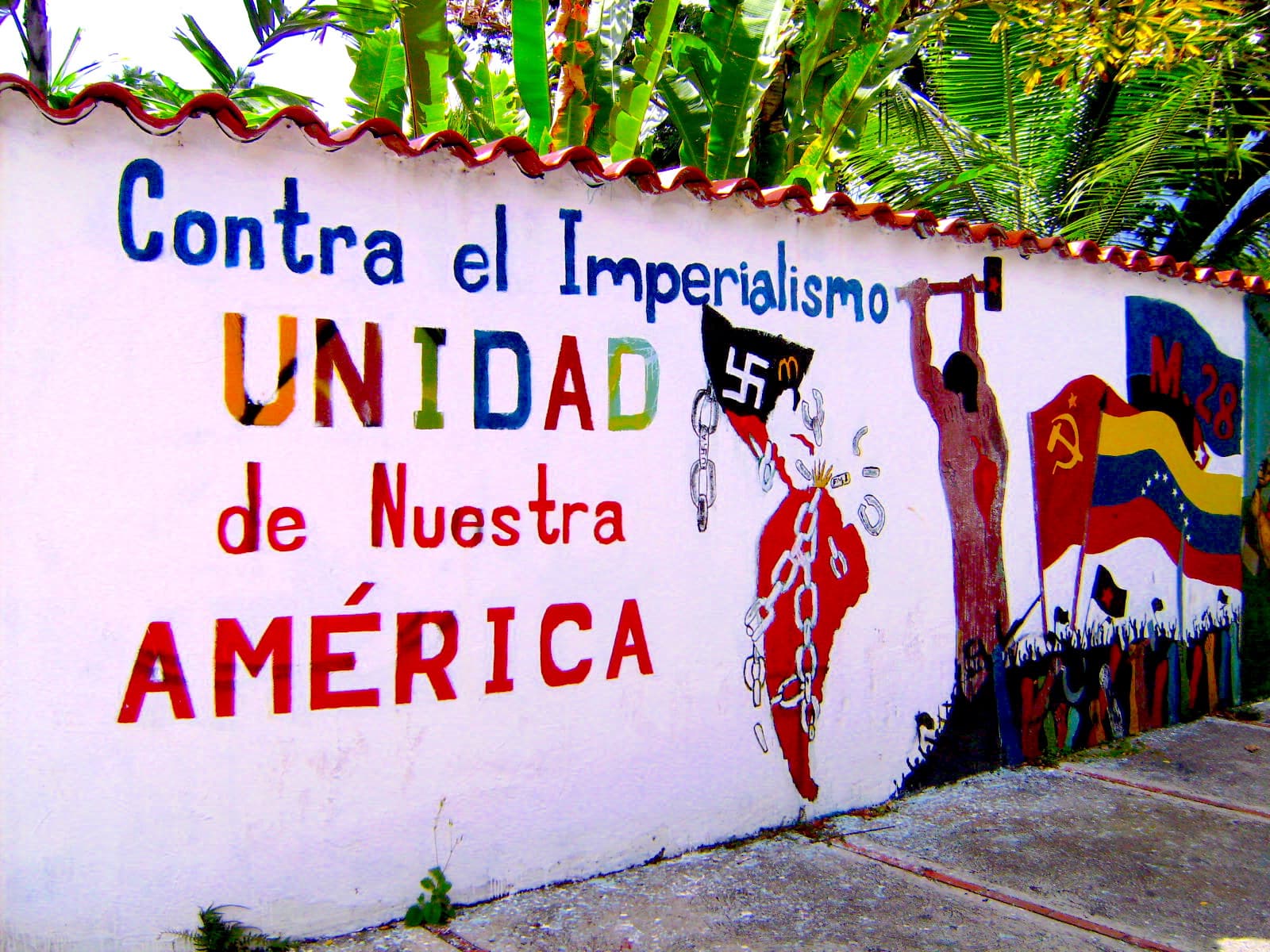
Bolivarian mural against Imperialism and the United States.Andreas Lehner
Venezuela and the ‘Donroe Doctrine’: Military Intervention and Imperial Fascism
In PerspectiveThe military assault launched against Venezuela on January 3 cannot be understood as a discrete or exceptional event. It constitutes a decisive moment in the reactivation of U.S. imperial strategy in what is understood as the Western Hemisphere, where geopolitical control of the Greater Caribbean, energy domination, and militarized containment converge with the resurgence of fascistic governance. Under the framework of the so-called “Donroe Doctrine,” the intervention articulates a broader project of imperial expansion that links extractive capitalism, authoritarian state power, and the erosion of democratic and emancipatory horizons both in Latin America and within the United States.
In the early hours of January 3, residents of Caracas, the Venezuelan capital, as well as the states of La Guaira, Aragua, and Miranda, witnessed the roar of aerial bombardments carried out by US armed forces. More than 150 aircraft —including fighter jets, helicopters, and drones— attacked military centers, airports, and strategic bases in the “energy heart” of the Greater Caribbean. At least 100 people, including civilians and Venezuelan and Cuban military personnel, were killed in the unilateral attack that resulted in the kidnapping of President Nicolás Maduro and his wife Cilia Flores.
Beyond a supposed strike against a narco‑terrorist figure, the military intervention in Venezuela constitutes the latest articulation of a protracted imperial siege against the Bolivarian revolutionary project. The promises of a political transition longed for by the Venezuelan diaspora[1] and internal political dissent, were ultimately reduced to the underlying strategic interests of the intervention: to ensure imminent geopolitical control of the Western Hemisphere that limits all external influence; the usurpation of the oil industry; control over the largest proven crude‑oil reserves in the world and mining sources in the Orinoco Arc.
It is worth examining the geopolitical implications generated by the intervention in Venezuela holds for Latin America within the current stage of US imperial expansion. At the same time, it becomes essential to identify the strategic foundations and ideological anchoring between imperialism and fascism that the “Donroe Doctrine” seeks to impose, including in the core of the same “Empire”.
In this scenario, recovering emancipatory political horizons is urgent. Such horizons must expand the creative fissures of popular resistance while breaking with the authoritarian power formations shaped by militarization and the subordination of politics to plutocratic capitalism and elite-driven state projects.
Chains of the Imperial Project
The reactivation of the Monroe Doctrine through the “Trump–Rubio Corollary” marks a decisive return to a pan-regional geopolitical order shaped by inter-imperial competition[2]. By asserting control over the Western Hemisphere as a matter of sovereignty and national security, the United States reiterates a long-standing imperial project rooted in the myth of Manifest Destiny. This project has sustained centuries of colonial expansion, indigenous territorial dispossession, interventionism[3], and counterinsurgency, enabling authoritarian governance, neoliberal restructuring, chronic indebtedness, and economic re-primarization across Latin America. While legitimizing a permanently failed yet violently destructive war on drugs.
Meanwhile, in the bowels of the empire, the shareholders of the military industrial and prison complexes, the techno-feudal elite, together with the Anglo-Saxon transnational petrocracy and the nefarious anti-immigrant and supremacist “Make America Great Again” (MAGA) movement converge with the plutocracy that today runs the US federal government. These forces drive the political economy of imperialism, even above the presidential narcissism in charge of the spectacle of lies in the White House.
Leninist premises help illuminate how imperialism—understood as the advanced stage of capitalism and the power of oligopolies—not only persists but is being recalibrated through an aggressive global neocolonial readjustment that articulates a new phase of recalcitrant fascism. This dynamic is visible within US society itself, which is experiencing a renewed surge of WASP (White Anglo-Saxon Protestant) supremacism, embodied in the MAGA movement and sustained through the construction of an “internal enemy,” alongside the intensification of extreme racism aimed at expelling, criminalizing, and annihilating migrant populations. The unrestricted persecution of intellectuals and universities—under the imperative to silence, criminalize, and prosecute critical thought framed as radical leftism or “antifa terrorism”—further accompanies the systematic dismantling of the welfare state and the erosion of democracy in all its dimensions.
The warnings issued by the Antillean thinker Aimé Césaire remain profoundly relevant:
imperialism and colonialism are engines of dehumanization whose violence returns like a “boomerang,” reappearing as fascism at the very heart of the colonial-imperial order.
The sophistication of contemporary “techno-feudal imperialism”, even as it complicates the arithmetic of capitalism and the dynamics of accumulation and dispossession, does not contradict the fundamental principles of brutalization exercised by the oligopolies and plutocracy in power.
The military assault on the Greater Caribbean: geopolitical control
The US imperial route throughout 2025, with the return of Trump and the techno-feudal plutocracy to the White House, has been exacerbated by the siege and systematic and growing interventionism in various countries around the world, with an emphasis on those of Nuestra America[4]. Its geopolitical premise has been clear: whoever dominates the Greater Caribbean will dominate the heart of the Western Hemisphere. The announcement of an urgent “recovery” of control over the Panama Canal and the decree unilaterally renaming the Gulf of Mexico as the Gulf of America has added to the persistent threat of annexing Greenland to US territory and the consideration of making Canada the 51st state of the American Union.
The recalcitrant neoconservative war rhetoric against terrorism launched at the beginning of the 21st century and the “historical fight” against drug trafficking dating back to the second half of the last century, intensified under the notion of fighting “narco-terrorism”, while a disastrous and volatile tariff war spread throughout the world.
Under the pretext of a virtual dismantling of the fictitious “Cartel of the Suns, President Maduro became the media target used by the Pentagon to justify unprecedented militarization in the Greater Caribbean. An unprecedented air and naval deployment began last September under “Operation Southern Spear”, which meant a sustained increase in aircraft carriers, destroyers, nuclear submarines, aircraft, and strategic bombers throughout the Caribbean arc. This was accompanied by the installation of a logistics network through negotiations—under military pressure—for the occupation of island territories that have reactivated bases, airports, and radars in Puerto Rico, Aruba, Curaçao, the Dominican Republic, and Trinidad and Tobago for surveillance, resupply, and intelligence. Thus, an operational encirclement was created around Venezuela.
At the same time, a series of systematic bombings was carried out against more than thirty five unidentified boats, resulting in the extrajudicial killing of over one hundred people under the claim—unsupported by any legal evidence—that they were part of a drug trafficking network bound for the United States. Added to this was a military assault campaign focused on the seizure of oil tankers, aimed at establishing de facto control over Caribbean waters and other international maritime zones along the Atlantic in order to appropriate all Venezuelan oil and interrupt energy flows between Venezuela and its main energy partners: China, Russia, Iran, and India.
In this context, the military intervention on January 3rd took place with the central objective of transferring Venezuelan energy control to transnational oil capital, containing a large-scale social uprising within the country, and reversing the historic relations between the Venezuelan regime and “American enemies”. Meanwhile, there are plans to deepen the isolation and accelerate the collapse of one of the most emblematic historical antiimperialist revolutionary regimes in the region: Cuba, for which the Chavista Petrocaribe project represented a vital source of income for two and a half decades.
With military intervention, threats against Mexico and Colombia have been expanded under the same scheme of fighting narco-terrorism, while threats of a forced annexation of Greenland increase. At the same time, political and electoral interventionism in Central America has intensified, as it was shown in the experience of Honduras. Imperial domination has extended across the Pacific strip of Latin American countries and the Andean region, where the extreme right governs. In other cases, the imperial project has established “political operation centers” in countries fully subordinated through indebtedness and ideological coercion, as seen in the governments of Argentina, Ecuador, and El Salvador. The reactivation and expansion of military bases have been accompanied by the development of a prison-enclave system—with its perverse market for the illegal transfer of prisoners and migrants—alongside efforts to tighten control over the South American lithium triangle (Argentina, Chile, and Bolivia) and to impose a regime of migration criminalization throughout the region.
Meanwhile, Latin American disintegration, expressed in the decline of regional integration agreements and political coordination projects, is intensifying in the face of the exacerbation of the political far right and the ideological polarization of the political ruling classes.
The Bolivarian Revolution and the exceptional oil wealth
Upon coming to power in 1999, Chávez promoted a new constitution and boosted a new political cycle in several Latin American countries, recovering the heritage of the Social Revolutions and the Bolivarian imagination enhancing a regional integration. With the new legal structure and the progressive consolidation of the United Socialist Party of Venezuela (PSUV), state control of the oil industry was restored in line with a global renationalization of the energy political economy (as occurred in Russia, Saudi Arabia, China, Malaysia, Brazil, and Iraq).
Venezuela became a strategic epicenter of anti-imperialist geopolitics and regional integration, supported by broad popular mobilization and aligned with the rise of left and progressive governments in South America that promised a transition beyond neoliberalism. The collapse of the U.S.-promoted Free Trade Agreement of the Americas (FTAA) in 2005 was followed by the creation of autonomous regional institutions outside the Pan-American system, alongside the expansion of People’s Summits and indigenous, Afro-descendant, and women’s movements across the continent. This conjuncture enabled the emergence of UNASUR and ALBA-TCP, fostering coordination between governments and popular movements and inaugurating a new phase of regional anti-imperialism that weakened the reach of the Monroe Doctrine.
In 2013, the Obama administration—through Secretary of State John Kerry—declared that the Monroe Doctrine was “over” and that a new era of cooperation “between equals” was beginning. Bolivarian geopolitics also played a key role in the creation of the Community of Latin American and Caribbean States (CELAC) in 2010, which included Cuba, long excluded from the inter-American system due to the US blockade imposed in 1960. This political convergence culminated in the declaration of Latin America and the Caribbean as a zone of peace and in calls for a new multipolar world order.
In this context, the loss of U.S. influence over Venezuela’s oil industry—combined with Chavismo’s strategic alliances with Russia, China, Iran, and OPEC—was perceived by hardline sectors within the Pentagon as a direct challenge. The Bolivarian Revolution’s central strategy of redistributing oil revenues through the so-called misiones—social programs aimed at poverty reduction and social equity—unfolded alongside growing industrial inefficiency and the progressive deterioration of the oil sector. Although newly certified reserves in 2010 placed Venezuela as the country with the world’s largest crude oil reserves, accounting for 17 percent of the global total, production declined sharply: from fourth place worldwide in 1980 to twenty-first by 2024, representing barely one percent of global output.
Despite Trump’s calls, most oil companies—aside from Chevron—have shown little interest in reinvesting in Venezuela, as restoring production capacity would require at least $110 billion. In the short term, control over Venezuela’s energy sector is therefore less about profitability than about limiting its ties with U.S. commercial rivals and weakening its strategic alliances, including an extreme energy strangulation on Cuba.
Beyond oil, Venezuela’s geopolitical significance also lies in its expanding gold production—up more than 300 percent in the past decade—and its reserves of cobalt and rare earths in the Orinoco Mining Arc, which are critical for military and advanced technological development.
The “Donroe Doctrine”? Fascism in the bowels of the beast
The Trump Corollary, articulated in the 2025 National Security Strategy, reasserts the Western Hemisphere as a top US foreign policy priority, emphasizing control over supply chains, critical materials, and the territories where they are produced. It explicitly seeks to restrict China’s access to regional infrastructure and strategic assets. Although border control and migration remain central to the intensified nationalist agenda—framed as the primary security threat—, the strategy combines border fortification with the authorization of operations in third countries to contain migratory flows.
This expansionist vision has been accompanied by an unprecedented level of political, diplomatic, and military aggression. Unilateral military actions before and after the intervention in Venezuela—in Iran, Syria, northern Nigeria, and the waters off Somalia—illustrate the escalation of armed force. At the same time, the Corollary’s confrontational posture toward the European Union, including threats to seize Greenland “at all costs,” calls into question the durability of the Atlantic Alliance through NATO, even as European states are pressed to meet a five percent defense spending target.
The “Donroe Doctrine” also has profound implications within the United States itself. The early months of Trump’s second term revealed the depth of techno-feudalism shaping the new architecture of government, exemplified by the appointment of Elon Musk—a central figure of oligopolistic technological power—to lead the Department of Government Efficiency (DOGE). This new body was tasked with aggressively reducing social spending and state bureaucracy, accelerating the dismantling of the welfare state. These cuts extended to development aid and international cooperation, sidelining decarbonization and climate change policies. One week after the attack on Venezuela, Trump further ordered the withdrawal of US funding and participation from more than sixty international organizations, including thirty-one United Nations bodies.
As Frantz Fanon argued, colonial domination reproduces violence as a structural condition, while the resistance of the colonized emerges through accumulated experiences of subjugation, persecution, and humiliation. Read internally, this colonizer–colonized relationship helps explain the fascistic turn of domestic politics in the US and a core objective of the MAGA project: to intensify social violence to justify heightened repression.
The aim is to normalize a permanent state of emergency capable of suspending democratic institutions.
The shift toward the fascist phase of the “Donroe Doctrine” did not begin with Trump’s first or second electoral victory, but with the attempted coup at the Capitol in 2022. That event exposed the scale and coordination of supremacist groups and their deployment as paramilitary forces capable of violently rupturing the institutional order—whether by attacking movements defending diversity and civil rights or, in this case, by storming the nation’s highest legislative body.
A clear indicator is the budget approved under the so-called One Big Beautiful Bill Act[5], which has transformed U.S. Customs and Border Protection (CBP) and Immigration and Customs Enforcement (ICE) into the state’s primary coercive apparatus, granting them unprecedented allocations for training, weapons procurement, deployment, and expansive discretionary powers. This control regime internalizes the border within U.S. territory through increasingly repressive policies. ICE has become the largest federal agency, authorized to exercise indiscriminate violence through racialized surveillance, the use of deportation against “ideological enemies,” and recurrent invocations of loosely defined states of emergency. In 2025 alone, these practices resulted in more than 70,000 arrests, approximately 350,000 deportations, and at least 30 deaths in ICE custody. The fascization of domestic policy thus intensifies the persecution of immigrants while destabilizing the very definition of US citizenship, now increasingly subject to reinterpretation under the rubric of “domestic terrorism.”
Margins for Emancipatory Resistance
Given the complexity of the current context and the overwhelming media machinery offering a wide array of purported “responses” and explanations for the invasion of Venezuela, the voracious return of imperialism, the resurgence of fascism, and the proliferation of simultaneous wars, the status quo appears far from being fundamentally challenged.
Which boundaries, then, must be redrawn—and in what ways—in order to deepen the fractures within the system and expand the horizons of emancipation?
The Hackeo Cultural Collective reminds us that “It is not enough to record and disseminate the facts: it is necessary to create common meanings, to look beyond the obvious and to clearly name the forces and agendas that promote authoritarianism, interference, and contempt for life. But also, to make living solutions visible.”
It is for this reason that they propose hacking a set of arguments that structure the hegemonic discourse of the media, academia, NGOs, and political experts: invasions are never carried out in the name of democracy, but rather to dispossess territories; it is necessary to move beyond the false opposition between left and right, since the task is not to defend flags or nationalisms but to weave solidarity among peoples; the recurring invocation of “democracy,” “dictatorship,” “drug trafficking,” and “terrorism” has functioned for more than a century as a recalcitrant and repetitive manual of domination; and international law and state institutions themselves face deep limitations, having been designed by hegemonic and imperial powers to administer colonial violence rather than to bring it to an end.
In Abiayala-Nuestra América, processes of territorial defense remain as active as they were prior to the invasion and the revival of the Monroe Doctrine. For Indigenous, Afro-descendant, and feminist movements in Venezuela, legal defense must be accompanied by strengthened local organizational capacity in the face of an intensifying assault on gold, coltan, and diamond territories. The defense of Mother Earth continues to be vital amid voracious extractivism and drastic cuts to international cooperation. In this context, the expansion of solidarity networks and the internationalization of local struggles through autonomous organizational platforms emerge as the most viable horizon in the face of an increasingly adverse future.
The No Kings movement articulates an emergency of politics protests rooted in the foundational principles of the American project itself: rights for migrant diversity, rejecting the plutocratic rule, and claiming civil disobedience, strategic non-cooperation, and transnational solidarity. In Minnesota, peaceful civil rebellion has intensified in response to Operation Metro Surge and the openly fascistic deployment of a federal agency functioning as a paramilitary arm of the ruling elite. This escalation has activated working-class and popular power, most clearly expressed in the mass general strike of January 26 under the slogan “no work, no school, no shopping.” In this process, the masks of “Donroe fascism” and its politics of brutalization are increasingly exposed and contested.
For this reason, the creation of narratives of self-defense against imperialism and media fascism constitutes a political terrain, one in which the collective reminds us that “this is not a battlefield where one must choose sides. It is a space of collective self-defense, where we exercise the capacity to name what we are living through, to recognize historical patterns, to identify lies, and to sustain memory and telling our own story…”.
Footnotes
- 1
By the end of 2024, the International Organization for Migration reported that: “more than 7.89 million Venezuelans are outside their country of origin, the second largest displacement in the world. [---] The majority of migrants and refugees from Venezuela reside in the region (6.70 million as of December 2024). Among the largest host countries are Colombia (2.8 million), Peru (1.7 million), Brazil, Chile and Ecuador”.
- 2
The panregions express a geopolitical model that supports the distribution of spheres of influence among the imperial powers of the main continental regions. It has been used at various times during the realignment of global power to claim the right to control and regulate political, military, economic, and commercial power in continental regions.
- 3
I am referring to more than fifty episodes of direct interventions by US forces in Latin American and Caribbean territories with the aim of altering the course of national policies, influencing, or changing their governments. This has been achieved using military force, orchestrating coups d'état, or funding groups that destabilize internal affairs. There have also been failed interventions, such as the Bay of Pigs invasion of Cuba, or the repeated assassination attempts against the leader of the Cuban Revolution, Fidel Castro. But in addition, the intervention has been indirect, through economic and cultural warfare, through economic and trade blockades, funding of internal opposition groups, diplomatic sabotage, and the criminalization of opponents through propaganda and cultural products.
- 4
I refer to the concept proposed by José Martí in his emblematic essay “Nuestra America” (1891) in which he critiques the foundations of US imperialism and claims for the Hispanic American countries and their peoples the right to preserve their great cultural, racial and linguistic diversity from their own American identity, which does not belong only to the Anglo-Saxons.
- 5
The One Big Beautiful Bill Act was signed into law by Trump on July 4, 2025. It constitutes a major federal statute advancing the administration’s second-term agenda, centered on tax cuts, deregulation, and a substantial expansion of funding for immigration enforcement and border security.

