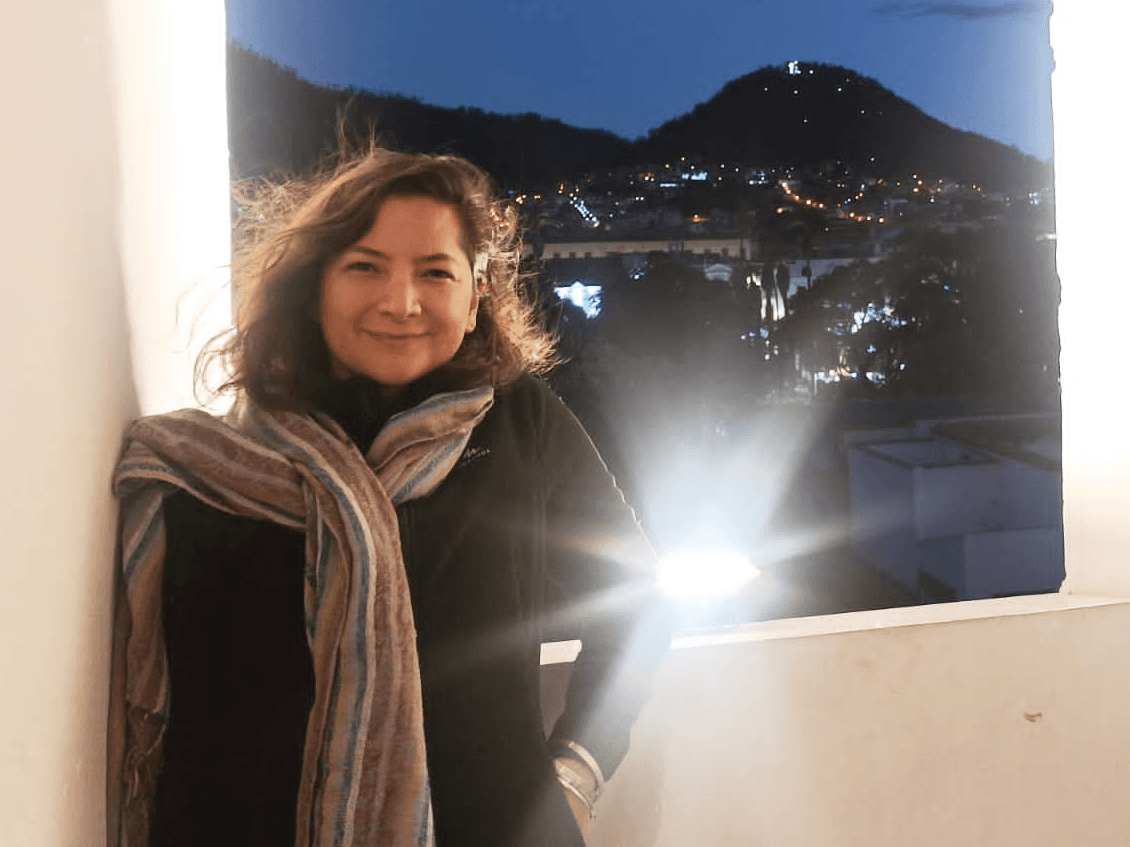

Mural "Rompiendo Cadenas" ("Breaking Chains") by the Bolivian artist Herminio Pedraza.
Authoritarianism and "Progress": Looking at Bolivia from the Crucible of Santa Cruz. An open dialogue.
Theory & Research In times of uncertainty and political transition, most of Bolivian society does not know where the country is headed after the presidential elections which culminated in a runoff on October 19. After 19 years, the Movement Toward Socialism (MAS, for its Spanish acronym) is leaving power. Having governed for nearly two decades, its hegemony has waned to the point that it now holds only one congressional seat. Those of us living in Bolivia are witnessing transformations in our territories that make it essential to incorporate local particularities into our analyses, avoiding the uniformity of national assessments.
How is “progress” understood in this territory? For whom is it intended? How has Bolivian society, particularly in Santa Cruz, been transformed in recent decades? Why speak of authoritarianism? Seeking collective answers to these questions—and opening the door to new ones—we met in July at a roundtable during the Congress of the Association of Bolivian Studies (AEB). This text summarises the reflections that emerged and presents a set of ongoing research projects.
Background
Santa Cruz is Bolivia’s largest and most populous department, located in the country’s far east and bordering Brazil, Argentina, and Paraguay. Unlike the Andean cordillera, it lies in the lowlands, composed of plains, pampas, and forests, including the Chaco and Chiquitanía ecoregions. Its natural resources, climate, and hydrography have long made it an area of economic interest—first for large estates and livestock farming, where land ownership sustained power and capitalist accumulation, and later for various extractive agro-industrial activities, such as sugarcane, rice, hydrocarbons, forestry, sorghum, and soybeans. The latter has integrated Santa Cruz into the so-called Soy Republic, a transnational zone shared with Argentina, Paraguay, Brazil, and Uruguay, dedicated to genetically modified soy monoculture, with its well-known environmental consequences: agrochemical use and recurrent forest fires. These dynamics have reinforced traditional forms of latifundia power, tied to family and political networks, now aligned with continental neoliberalism and expressed through civic movements that shape the Santa Cruz identity.
Researching in and from Santa Cruz: a space for dialogue.
On July 21, 2025, as part of the 12th Congress of the Association of Bolivian Studies (AEB), my colleague Vania Rueda and I coordinated Panel 22: “Researching in and from Santa Cruz, interdisciplinary dialogues against the hegemonic narratives of this region.” For us, academics and collectively organised researchers, it was essential to consider a set of reflections and concerns generated in and from Santa Cruz. Understanding that territories are alive and complex, Santa Cruz occupies a particular place in the national and Latin American imagination, marked by the agro-industrial advance and a growing real estate boom. This “progress” is embodied in certain protagonists, forms of power, and civic discourses that organise the hegemonic society of Santa Cruz, while rendering invisible the asymmetries and problems that accumulation and dispossession generate in territories and their inhabitants.
The roundtable sought to facilitate dialogue between researchers who question these hegemonic narratives, which portray Santa Cruz as distinct from Andean Bolivia and as the country’s economic centre, led by a landowning elite strengthened by neoliberal growth and represented by the Pro Santa Cruz Civic Committee. Although associated with right-wing conservatism, support for agroindustrial incentives cuts across the political spectrum. These narratives promote “economic progress” and a mestizo identity, reflecting conservative values and entrepreneurial aspirations.
Against these narratives, the dialogue unfolded along two lines: critical investigations into local hegemonic power, and post-critical approaches exploring alternative possibilities for this territory.
Against historical and memory narrative.
From the fields of museography, visual arts, and archives, Isabel Collazos presented the paper: ‘Confronting the history written in the museum: the transformative potential of critical perspectives’, while Angélica Becerra presented: ‘Counter-apocalyptic archives to reimagine Santa Cruz’. Both studies question, from critical perspectives, the aesthetics and visualities with which this region is represented. Isabel tours the Santa Cruz History Museum and makes it strikingly clear how the curatorship and museography of this institution asymmetrically exhibit and reproduce the history of indigenous peoples in comparison to that of Santa Cruz’s intellectuals, led by independence fighters, founders, painters, and thinkers. All of them are men —white or mestizo —represented in traditional images. For her part, Angélica, from the perspective of urban feminist struggles, presents two cases that she calls counter-archives, in that they oppose this visual imaginary: a street protest generated by the post-presidential election conflicts of 2019, and a feminist party in the context of the conflicts between the regional elite and the central government over the 2022 census. Both cases reflect the emergence of aesthetics antagonistic to Santa Cruz's hegemonic aesthetics, demonstrating that visual representations, in institutions and on the streets, are also a field of political dispute. Isabel and Angelica’s research precisely politicises these other conflict scenarios in Santa Cruz.
What is the subject of progress?
The paper by researcher Vania Rueda: ‘Colonial Otherness Present in Camba Identity’, addressed the identity composition of Santa Cruz society from a decolonial perspective. Her analysis focuses primarily on the mestizo character and its centrality in the discourse and construction of Camba identity, where mestizaje is constituted in opposition to the indigenous, not as a fissure in colonial history, but instead framed within a continuum of coloniality that denies the presence of the chixi, which, according to Silvia Rivera Cusicanqui, is that which cannot be synthesized and coexists in constant contradiction in a society. Camba identity is hegemonised by a mestizo subject who is mainly male. For her part, Arleth Escobar wonders what happens to women. Her research, ‘White feminism and empowerment and exclusion in Santa Cruz capitalism’, refers to the association of women entrepreneurs who bow to the values of liberal capitalism as white feminism, generating alliances and articulating networks of power in tune with civic spirit and local/transnational business. Arleth’s findings reveal the contradictions between the discourse of these groups, which claim to fight for gender equality, and the practices that exclude women traders or are supported by popular networks in Santa Cruz. It is, therefore, a form of feminism that bends to capitalist growth.
The narrative of Santa Cruz and civic spirit.
When analysing local power, Quya Reina presented the research “Cruceñidad: What myths accompany contemporary identity?” This study explores the concept of cruceñidad and the historiographical threads that affirm this construct, arguing that they do not reflect today’s Santa Cruz society, given the transformations it has undergone, thereby questioning the imaginaries and myths constructed by institutions of power. Quya’s work dialogues with my research “Social Disorganisation and Power Pacts in the Age of Progress: Recent History of Santa Cruz”, in which, based on an analysis of social conflict, I argue that there is a disruptive dynamic within institutions known as cruceñidad or civism, such as the Pro Santa Cruz Civic Committee, because their own dynamics prevent various groups from other sectors from organising and participating as civil society. Both investigations agree that the political institution that has appointed itself as the representative of Santa Cruz society is no longer representative, since transformations brought about by migration and capitalist development no longer reinforce the discourse of a homogeneous identity.
In her presentation “Everything is Ashes: Variegated Territories in the Bolivian Chiquitanía”, Marie Jasser analyses rural Santa Cruz through René Zavaleta Mercado’s concept of variegation, highlighting the transformations in a region suffering accelerated dispossession by agribusiness, where different ways of organising life coexist under the constant threat of forest fires. From this perspective, Marie explains how various actors operate through agreements, struggles, alliances, and resistance in the Santa Cruz region.
What has been transformed?
Beyond the hegemonic discourse, it is necessary to consider other narratives that inhabit and coexist in this territory. Marianela Diaz’s presentation, entitled ‘Memories of coffee’, invites us to reflect on the experience of the people who sell coffee in Plaza 24 de Septiembre, a central and prominent space in Santa Cruz. For this exercise, Marianela proposes the concept of the palimpsest city, in which diverse cultures overlap and contribute to the configuration of urban space, specifically the migrant movements of coffee sellers, which tend to occur in waves. This allows us to dismantle the official discourse of the classic disputes between the inhabitants of the east and west of the country, in which the hegemonic narrative constructs Santa Cruz's identity in opposition to that of the Andes. The truth, in this case and the others, is that these identities coexist and overlap in the public space, with migrants from different parts of the country sustaining these economic activities and recreating the sense of identity in Santa Cruz society.
From this perspective of international relations, researcher Toshiro Miki’s paper: ‘Santa Cruz: what we understand of its geopolitics between regional ambitions and limitations’, reflects on a perspective constructed to think about geopolitics not only based on permanent conflict between the region and the state, but rather from the functional cooperation in Santa Cruz’s relationship with Bolivia and neighbouring countries. In his work, he traces historical proposals for international ties in which space is understood differently from state and regionalist perspectives, dismantling the supposed antagonism from a pragmatic perspective.
But international relations are not only concerned with studying government policies at the central or departmental level, as Sebastián Diez makes clear in his research ‘Peruvian migration in Santa Cruz, in which he analyses the recent transformations in migratory flows that have turned this department into a magnet for migrants, both from other areas of the country and from countries that do not share a border with this region, as is the case with Perú.
These studies invite us to think of Santa Cruz as a space in constant transformation, shaped by new migratory flows and socioeconomic shifts that articulate different discourses, identities, and cultural practices in tension and coexistence.
Common ground in the face of authoritarian discourse in a transformed society.
The research presented challenges hegemonic narratives and their authoritarian traits in Santa Cruz from various perspectives. They dissect aspects of Santa Cruz society, its historical, identity-based and socioeconomic formation, linked to land ownership and the advancement of agribusiness, as well as the formation of civic discourses and practices that conceal structural asymmetries through the construction of a homogeneous narrative with strong employer, patriarchal, and racist overtones, which seeks to impose a uniform history of the territory and its inhabitants, in which social and economic “progress” is attributed to the actions of white and mestizo men, as well as some women linked to this Santa Cruz identity, who are the protagonists of the development and constitution of a local power materialized in a civic institution that represents only a few.
These studies demonstrate how the construction of this narrative employs the force of dispossession, imaginaries, and myths of progress, all of which are historically present in the region and exhibit authoritarian characteristics. Authoritarianism stems from a history of patronage and large landholdings. Still, over time, it has acquired new attributes within the framework of neoliberal extractivism, making it clear that these hegemonic narratives, while updated, are no longer consistent with today’s Santa Cruz society and its many transformations. Therefore, it is essential to strengthen research processes that add complexity to the situated analysis of these phenomena, avoiding the homogeneity of national overview studies.
These contributions help us to think of Santa Cruz as a region in transformation, composed of diverse territories where different forms of production and ways of organizing life coexist, viewing the city as a palimpsest in which cultural identities and meanings not only compete, but also overlap and coexist, in a camba/mestizo identity that is not homogeneous, but rather in constant tension, dialogue and contradiction, with influences from migratory movements and the processes of organization and disorganization of civil society. All this complexity, the magnitude of which has yet to be fully explored, invites us to break with the hegemonic narratives constructed about the region, posing the urgent challenge of characterising its features, which are constantly in transformation and movement.