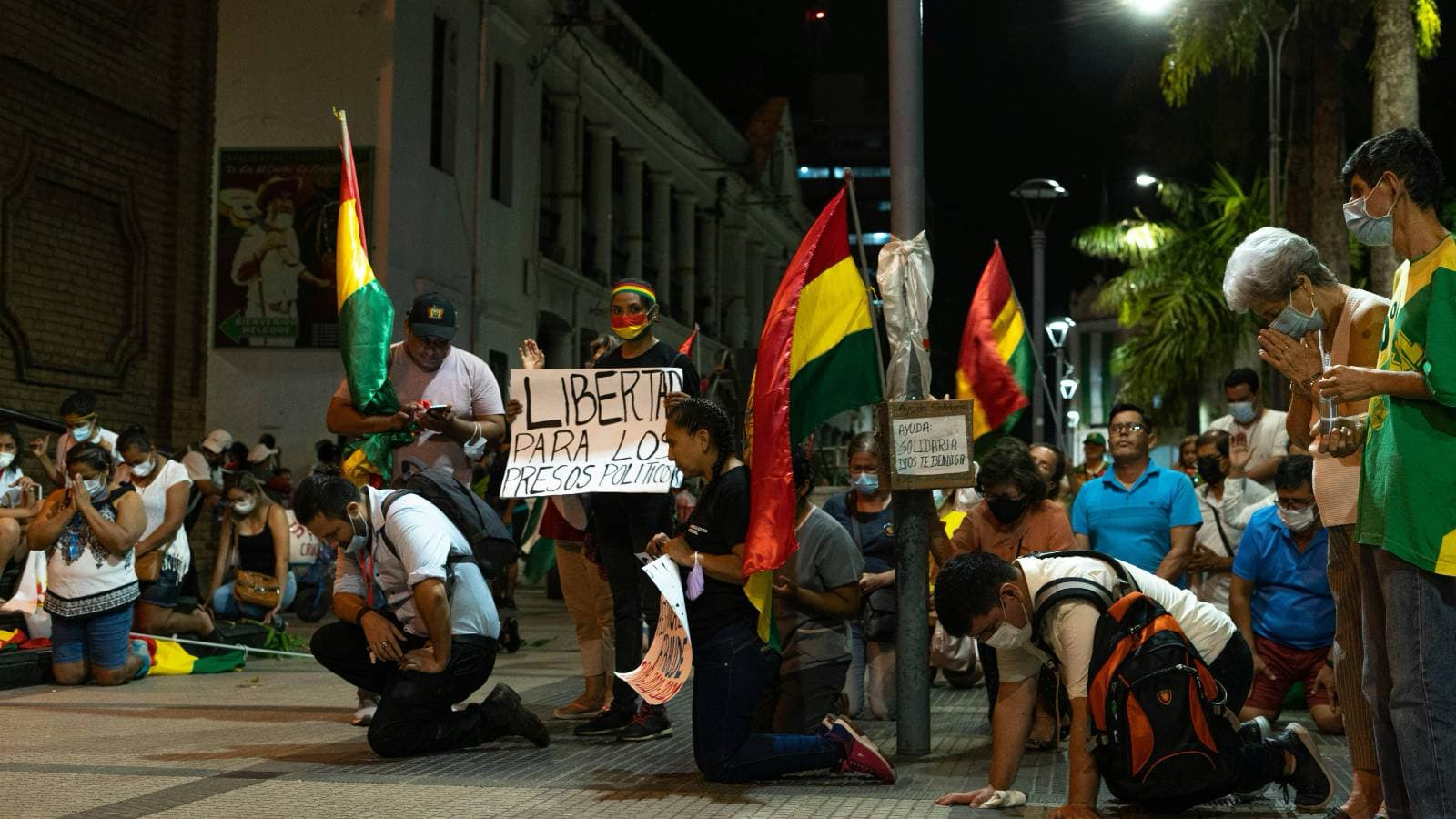
Bolivians Protesting on City Street during the Conflicts 2022, Santa Cruz de la Sierra, Departamento de Santa Cruz, BoliviaPhoto by Geo Souza from Pexels
New generations and (not so) new authoritarianism in Bolivia
In PerspectiveThe advance of the right wing in Latin America, accompanied by its rise to power in countries such as Argentina, Ecuador, Bolivia and Chile, has been marked by the emergence of “new” discourses centered on security, order, meritocracy, and the reduction of the State. Yet these narratives are not simply innovative political proposals. Emerging in a context of socio-economic crisis, institutional breakdown, and generational uncertainty, they recycle authoritarian and conservative measures while presenting themselves as pragmatic solutions to instability. Drawing on the Bolivian case, Claudia Cuellar Suárez explores how these ideas gain traction among young people, asking what kind of political ideology is winning over Generation Z and how weariness, vulnerability, and the search for “real solutions” are reshaping the contemporary political landscape.
The advance of the right wing, and its rise to power in several Latin American countries (such as Argentina, Ecuador, Bolivia and Chile), brought with it “new” discourses and narratives (security, order, anti-immigration policy, economic adjustment, reduction of the State, defense of the nuclear family and the nation, close relationship with the United States, among others) as well as promises of transformation that are reflected in a supposed antagonism to the progressive cycle that preceded it. However, these ideas, which claim to be innovative, are in fact a recycling of the authoritarian and conservative measures that our parents and/or grandparents already experienced. Despite this, they are promoted and defended by a large part of the population, with an unusual protagonism of the new generations. In this article, we ask ourselves why these ideas are politically attractive to the youth, in light of the Bolivian case.
In Bolivia, one of the longest-standing progressive governments on the continent, there are few studies on how children and young people have transformed their socio-political ideas over the last few years, or on how these ideas influence the way new generations think and live the country. An example of this lack of knowledge was the election of Rodrigo Paz and Edman Lara, who enjoyed broad support among young people, with new ideas such as meritocracy, pragmatism, green business, dismantle bureaucracy, and other that won the youth vote. But after the reflux of electoral times, the questions remain: What kind of political ideology is winning over the well-known Generation Z in Bolivia?
I resort to two investigations carried out with young people in the country. One of them, conducted between 2017 and 2018, called ‘What democracy?’ ["¿Qué democracia?”[1]] whose focus was on young people who protested - in the city of Santa Cruz de la Sierra- against certain aspects of Evo Morales’ progressive authoritarianism, in his quest to be re-elected once again as president, ultimately aiming for a conservative horizon. I establish a bridge between this research and more recent conversations held with young people between the ages of 18 and 28 in the cities of La Paz, El Alto, and Santa Cruz de la Sierra as a part of the study ‘Being young in times of multiple crises. Political narratives and the construction of meaning’ [Ser Joven en tiempos de crisis múltiple. Narrativas políticas y construcción de sentido [2] ]. A study conducted with young people in 2024, in the context socio-economic crisis that the country was going through, with the purpose of knowing their ideas and how they affect the present day and the attraction towards horizons marked by meritocracy and political pragmatism.
On democracy. Criticism of progressivism and new youth platforms.
In deterioration of Evo Morales’ government, a new form of occupation of public space emerged, among these were the blockades in the city of Santa Cruz de la Sierra (where different forms of organization appeared by taking the streets through the so-called pititas, but also prayers and sermons as political action). These were youth platforms and other groups that opposed the Morales’ re-election as president under the slogan ‘Bolivia said NO’ [“Bolivia dijo NO” [3] ]. In these demonstrations, among a diverse conglomerate of opposition groups and individuals, discourses emerged that appealed to identity and religion, as well as the defense of democracy. They were mainly young people expressing strong discontent with the evident authoritarian character of the progressive government which sought to perpetuate itself in power.
But what was behind this movement? The research ‘What democracy?’ [“¿Qué democracia?”] revealed the conservative traits behind these discourses. We investigated 12 youth organizations created ‘in defense of democracy’, asking them how they understood and practiced this concept.
Among the most frequently repeated interests in their responses, we could see that they were mobilized by the defense of freedom, the family and meritocracy.
It is worth saying that in these mobilizations they coexisted with a broad and heterogeneous group of civil society communities, including environmental groups and the feminist wave that was emerging throughout almost all of Latin America, who from another side showed an anti-authoritarian struggle against the MAS government.[4]
One of the relevant findings of this study was to identify that, under the democratic narrative or imaginary, conservative discourses emerged anchored in preserving the nuclear family and freedom, the latter understood as free market and meritocracy, as well as the reduction of the State. Perhaps it was the subsequent conflicts that took place in Bolivia in 2019[5] and 2022[6], those that did not let us glimpse where these narratives that appeared very incipient as a defense of democracy, but were increasingly leading to a conservative horizon:
“Almost all the groups investigated claim that the motives for organizing and politicizing themselves were the defense of Freedom and Democracy. The exception lies in the Christian groups, they claim that they are organized in defense of the values they share, that is to say, the defense of their ideals of life and family. In the conversation with representatives of Casa de la Juventud, it is possible to glimpse a meaning of the term Freedom associated with the resistance of the individual against the State. In this State-individual opposition it is claimed that, during the MAS government, economic freedoms have been reduced and the tax regime for companies has been overburdened. Undoubtedly, despite the repeated denials of ideological orientation and party affiliation, one can see a strong liberal thinking and with orientations to capitalist economic rationality” (Cuellar et al, 2018)
When asked about the democratic slogan promoted by these groups, it became clear that they were betting on a change of government, but without questioning the authoritarian aspects of the way in which it exercised its power. The interviews showed that they were seeking a change of government, not so much to delve into democratic values, such as addressing class, gender, and race inequalities or carrying out a policy of memory against military dictatorships.
A clear example was the emergence of strongman rule visible as opponents to the government of Evo Morales and the MAS, personalizing and individualizing the collective character of these demonstrations. The exception to this was the feminist resistance movements, which have been reluctant to accept these forms of leaderships and political organisation.
Seven years on: weariness, vulnerability and uncertainty
The conflicts that arose in 2017, and reinforced by the strong institutional breakdown of 2019, could not be stabilised during the second MAS government, this time with Luis Arce Catacora as president (2020-2025), revealing a country that was increasingly entering into a deep political and economic crisis.
In this context, a second study, conducted in 2024 with young people who were not necessarily politicised or involved in civil society platforms or organisations, revealed a general weariness among young people with the public and political life of the country. There was a widespread tiredness from the power groups and the economic collapse, a situation that imposed on many young people the need to migrate in search of sustenance. In this sense, the ideas of meritocracy, anti-corruption and pragmatism are those that more attracted their attention, associating them with processes of transformation and new opportunities, in contrast to the old ideas of nationalization, cultural revolution and collective rights.
Regarding the latter the so-called Generation Z recognizes that some rights have been consolidated, while others seem to be “empty words” that have not transformed their daily lives.
Another characteristic of these conversations, held after several years of economic crisis mainly due to shortages of foreign exchange and fuel, has been the recognition that a generation is passing through vulnerability. On the one hand, expressed in the precariousness that they must assume due to labor instability, access to housing, among other things, as well as a sense of uncertainty about the future and the crisis to come due to the effects of climate change. Added to this concern, is the importance they attach to mental health in relation to previous generations where anxiety and depression were not social problems, Generation Z recognizes them and experiences them as such.
In a way, this panorama of weariness, vulnerability and uncertainty allows us to understand the fertile ground in which the attraction towards “pragmatic” discourses for managing economic crises is expressed. But also, as Suely Rolnick says, how the management of fear is a political strategy of reactionary sectors in the installation of fictional narratives that legitimize them. Thus, “the idea that they are all ‘of the same kind’ adds disappointment to insecurity and fear, generating a sort of apathy due to exhaustion” (Rolnik, 2019: 147).
“Change” in the form of “outsiders”
As a prelude to the presidential elections, we saw a generation that seemed increasingly detached from the traditional politics and its forms of organization, as well as alien to the narratives of social transformation promoted by the left, tired of the supposed antagonism between left and right. When asked about the leaderships of Latin America, the name of Bukele emerged as a reference, who stood out for being president with “tough hand”, but mainly for his pragmatism. Tired of “empty” ideological battles, the responses were directed towards the search for “real solutions”, to sensitive problems such as security. The latter explains, not only in Bolivia, but also in other countries of the region, an important part of the attraction to outsiders in traditional politics as a pragmatic solution.
Rodrigo Paz is not a new figure in Bolivian politics. He is the son of a former president, grandson nephew of another, and has been mayor and senator of Tarija, a city in the south of this country. He presented himself as an outsider because it was his first presidential election, in an electoral scenario marked by the decline not online of the ruling party, but also of the other candidates, many of them recycled from previous elections.
But above all, he stood out for its discourse aimed at “saving” the economy, encouraging meritocracy, caring for the environment, strengthening security and fighting corruption.
Bet in which he established a duo with Edmand Lara, as Vice President, a former police officer who achieved great public notoriety for denouncing cases of extortion and corruption in the National Police of Bolivia. This profile not only made him go viral on social media, mainly TikTok, but also brought him political gains by aligning himself with the prospects for change held by the new generations who grew up under the progressive government. All this with a discourse of unity that appeals to God, the Homeland and the Family, as an obvious sign of the change that has taken place in politics as a result of many years of wear and tear.
What we are experiencing today.
The youth, new generations, or the so-called generation Z in Bolivia, are still an open field to know and recognize, beyond the classic way in which it is studied as a ‘mass’ in electoral times or as a segment of consumers of brands.
Rodrigo Paz, who has promised meritocracy, anticipates the consolidation of another circle of power so feared by young people in the run-up to the elections; we are still experiencing this circle composed mainly of technocrats and entrepreneurs from the private world. But what, if you account for it, is that the form of government from the technicality and the concentration of the decisions in the executive organ, are instituting a phenomenon that already sees coming in these right-wing governments: the dismantling of rights from through cuts and the supposed solution to the crisis.
These components became evident between December 2025 and January 2026 with the promulgation of Supreme Decree 5503. The Decree was questioned by various social sectors, as it proposed a profound and abrupt economic reform through what they called a ‘state of economic, financial, energy and social emergency’, conferring exceptional powers on the Presidency over deliberative bodies such as the Legislative Assembly.
The social protests deployed in different parts of the country managed to stop this decree, showing resistance to this way of governing through decisions centralized in a technocratic authoritarianism. However, despite the general discontent expressed by various workers’, farmers’, miners’, students’, and urban workers’ organizations, demands are ultimately negotiated in a sectoral way. This situation is not very different from previous governments. Although some young people continue to mobilize for environmental problems and the demands they consider just, faced with weariness with traditional politics, many have opted for technicalities and the promise of meritocracy. Identifying the authoritarian traits in these forms of government remains a challenge.
Footnotes
- 1
Cuellar, C. Morales, D. Vaca, M. Romero, C. Álvarez, G. ¿Qué democracia? Revista Paradigmas, Universidad NUR, noviembre 2018.
- 2
Mokrani, D. Chavez, P y Cuellar, C. Ser jóvenes en tiempos de crisis múltiple. Narrativas políticas y construcción de sentido. Documento de debates de OXFAM, febrero 2025.
- 3
“Bolivia said No” refers to the referendum held on 21 February 2016, in which 51,30% of the population opposed re-election.
- 4
‘Movement to Socialism’ [Movimiento al Socialismo], political party of Evo Morales.
- 5
After the 2019 presidential elections, a strong political conflict broke out, causing an affront to public space and the country’s governability.
- 6
The year 2022 saw a period of conflict that increased regionalist speeches, mainly motivated by the demand for the 2023 census from civic institutions in the department of Santa Cruz. Link: https://www.ojala.mx/en/ojala-en/organizing-a-feminist-horizon-against-all-fascisms?rq=claudia%20cuellar
- 7
Cuéllar, C. Organizing a feminist horizon against all fascisms. Ojalá, México, 6 marzo 2023.
- 8
Cuellar, C. Morales, D. Vaca, M. Romero y C. Álvarez, G. ¿Qué democracia? Revista Paradigmas, Universidad NUR, noviembre 2018.
- 9
Mokrani, D. Chavez, P y Cuellar, C. Ser jóvenes en tiempos de crisis múltiple. Narrativas políticas y construcción de sentido. Documento de debates OXFAM, febrero 2025.
- 10
Rolnick, S. Esferas de la insurrección. Apuntes para descolonizar el inconsciente. Buenos Aires: Tinta Limón, 2019.