Gala Abramovich
A Laboratory for Queer Anti-Fascism: Lessons from Argentina Under Milei
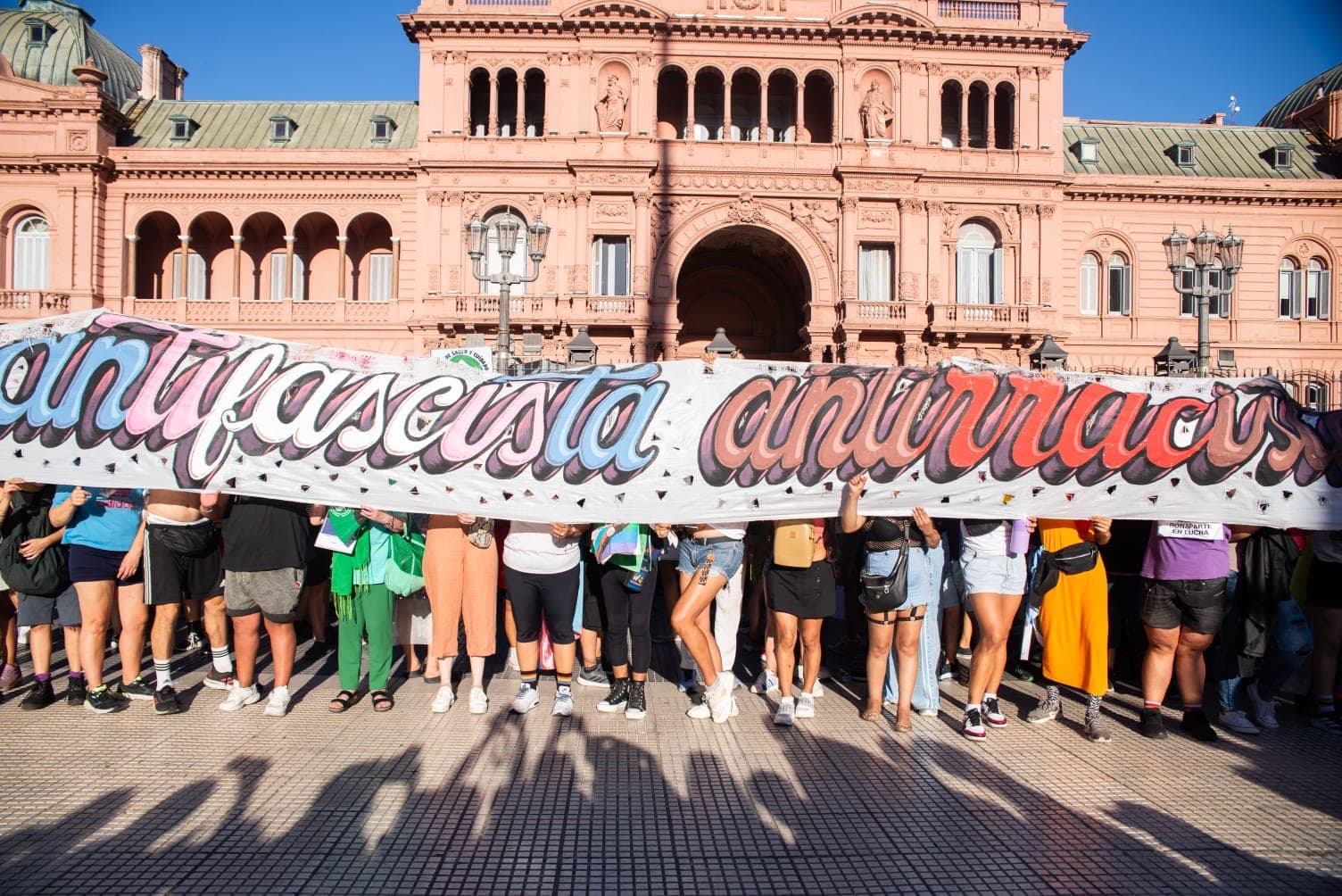
In PerspectiveIn February 2025 the LGTBIQ+ movement organized a massive demonstration in Argentina, against the libertarian government, the president’s homophobic remarks at Davos and his permanent hate speech. It was the first Anti-fascist, Anti-racist, LGBTIQ+ demonstration and it was huge because it managed to mobilize sectors that had rarely mobilized in protest against Milei. In this article we want to analyse what happened that this particular event was able to articulate so many different groups. But also, we propose an explanation for why that movement weakened, giving way to a small demonstration one year later, and how we might regain strength again.
You probably heard of Javier Milei. Argentina’s president is part of a constellation of far-right figures—alongside the Bolsonaros, Trump, Meloni, Orbán, and Kast. They frequently gather to exchange agendas at events such as CPAC and the Transatlantic Summit. Argentina has been cast as an experiment—a laboratory for the world: never before have such extreme ultraliberal austerity measures been tested in combination with a "cultural battle" aimed at redefining our very understanding of rights, labor, and the commons. Moreover, this campaign seeks to use traditional values to "restore order" to the "disorder" allegedly introduced by feminism and the LGBTQ+ community—movements that have secured some of the most significant rights achieved in our country over the last two decades. For this very reason, Argentina serves as a laboratory of a different kind as well: a laboratory of resistance, of political creativity, and of the potential to set limits on this government—all within a global context characterized by multipolarity and a crisis in the human rights paradigm.
We are in Buenos Aires, Argentina. It is Thursday, January 23, 2025. In various WhatsApp groups, people begin commenting on President Javier Milei's speech at the World Economic Forum in Davos. Instead of his usual lengthy, soporific monologues about economy, this time he chose to focus on woke ideology — that heterogeneous catch-all notion in which human rights organizations, anti-racist collectives, environmentalists, feminists, the LGBTIQ+ community, and trade unionists all coexist.
“Today I stand before you to declare that our battle is not yet won; that while hope has been rekindled, it remains our moral duty and historical responsibility to dismantle the ideological edifice of toxic Wokism. Until we have succeeded in rebuilding our historical cathedral—until we have persuaded the majority of Western nations to once again embrace the ideals of liberty—until our ideas become the common currency within the very halls hosting events such as this one, we cannot lay down our arms. For—I must say—forums like this have played a leading role in promoting the sinister agenda of Wokism, which is inflicting such grave damage upon the West.”
“(...) I want to be clear that when I speak of abuse, it is not a euphemism; for in its most extreme forms, gender ideology constitutes—plain and simple—child abuse. They are pedophiles; therefore, I want to know who condones such behaviors.”
Milei speaks before a sparse audience about how we distort "Western values" — as empty a signifier as any — about our intrinsic socialism and the secret intention we supposedly harbor of turning desires into rights and thereby disputing the expansion of the state. In keeping with the culture war he wages, Milei needs to turn us into internal enemies, into objects of hatred. To dehumanize us. Because in the ultraright playbook, we are generally easy to convert into scapegoats. According to his formula, if capitalism is failing it is not your fault, nor the fault of the wealthy who accumulate 99% of the world's profits. The fault lies with that segment of society that believes it can have rights, and that received some recognition for years of exclusion — and very rarely a modest redistribution — thanks to a handful of inclusive public policies. Policies that were not gracious gifts; they were hard-won conquests, the product of decades of political struggle.
As an added element, we are historically the target of conservatives of all stripes — a common enemy for every faction of the right that finds in Milei its perfect president.
It is no coincidence that he focuses on this misshapen and diverse "us": we still embody that collective that dreams of and fights for a more just and freer world for everyone.
Emboldened as he is, that day in Davos he says that wokism wants to convince the world that a man can be a woman and vice versa. The president goes further: he says there are same-sex couples who abuse their children. That gender ideology in its extreme form is pedophilia.
From that point on, like a trail of gunpowder, indignation and anger were transformed into a call to action. Invitations to join next Saturday’s assembly spread in a thousand formats — word of mouth, via Grindr, in new WhatsApp groups of self-convened participants, on Instagram, TikTok, and X. More than a million people took to the streets in Buenos Aires, with demonstrations in capital cities across the country. A resounding limit was drawn against violent, stigmatizing discourse, one that also built an unprecedented transversal and multi-sectoral political event.
A year later, Milei was back in Davos — but his strategy had shifted. Rather than directly attacking the LGBTIQ+ community, feminism, and "gender ideology," he opted for a different approach. In 2026, he attempted to crack the very idea of social bonds, community, common good, and collective emancipatory horizons. Like a fledgling Margaret Thatcher, his struggle — the struggle of these neo-reactionary conservatives — is to loudly proclaim that society does not exist; there is only an aggregation of individuals who might just as well be isolated. If the culture war seeks to demolish the possibility of organizing transformative activism, in 2025 it attacked some of the most dynamic militant movements. A year later, he doubled down: all his chips placed in the service of atomization and the repressive defense of private property. On the contrary, the anti-fascist, anti-racist, LGTBIQ+ demonstration was relatively small and primarily mobilized the most activist members of the queer community. Why was the February 2025 march so successful? What happened to those elements over the course of the following year?
What We Had in 2025
There are three elements that are key to understanding the success of this march: transversality, communication, and the vocation for building a broad front.
Transversality in two senses: in Argentina both feminisms and the LGBTIQ+ community are core movements of political engagement that encompass multiple struggle agendas. We have grown accustomed to trafficking activisms and to cross-pollinating diverse demands for social justice. The demonstration was multi-sectoral from the outset. On the other hand, queer people exist across all social classes, in rural and urban areas, in large capitals and small cities, working in the state, teaching, and even voting for Milei.
This had a multiplier effect: the indignation was definitely not confined to a small group of Buenos Aires activists.
On January 31, 2025, days after Davos speech, Yamila Cafrune — daughter of the legendary Argentine folk musician Jorge Cafrune — introduced trans singer Ferni at the Cosquín Festival, Argentina's most traditional and family-oriented celebration… broadcast on national television. Old ladies from the audience were moved to tears — surely thinking of their queer sons, their lesbian granddaughters, the trans hairdressers from the neighborhood. Hatred and cruelty were thus showing their concrete limits as a mass politics.
In terms of communication, centralization and decentralization were part of the same political tactic. Everyone made their own flyer and shared it, both for the assemblies and for the marches. An official Instagram account was set up to give visibility to each of those graphic pieces. One of the organizing groups, Columna Mostri, offered their WhatsApp group as a space for conversation about the logistics of the demonstration. Strategic meetings were held to invite more comrades and organizations to join the Buenos Aires assembly. Some influencers served as strategic allies for dissemination on social media. Federal networks began pooling the calls to action from across the country, and comrades skilled in open-source geolocation tools built an impressive map. Press coverage was handled by journalist comrades, graphic designers, and reporters who had been part of the assembly from the start, managing to secure media coverage in the country's major newspapers.
None of this could have been achieved without a strategic awareness of the role of broad fronts in contexts of growing fascistization. Left-wing militants, Peronists, Kirchnerists, anarchists, self-convened participants with no prior political experience, human rights activists: we all understood that the risk of fragmentation was very real. The first assembly established that anti-fascism was the umbrella that united us. We chose to call ourselves anti-racist, as well as LGBTIQ+, because we come from a country where, even though class and race overlap, we have bought into the neoliberal discourse of meritocracy and often pretend otherwise. In light of what we achieved, we know it was an excellent strategy to come together despite our differences. We also know that it was difficult to build much more than a massive march. We were unable to construct a stable coordinating structure. And we came to understand that we are not exempt from the same fractures and tensions affecting politics more broadly in Argentina: the notion of representation, trust in leadership, the willingness to put the common good ahead of individual interest, they are all facing a crisis.
What We Kept and Lost
All of 2025 unfolded under the weight of structural pressures that made sustained organizing increasingly difficult. The October midterm elections, in which Milei's party expanded its parliamentary representation with significant backing from the United States government, shifted the balance of power decisively in favor of the ruling coalition. Donald Trump appeared to condition a $20 billion currency swap deal with Argentina's central bank, and an additional $20 billion loan from private banks, on a good showing for Milei in the national midterms, threatening to rescind the assistance for the cash-strapped country in the event of a the victory of the opposition party.
Economic violence became a key instrument of demobilization: with many activists working twelve to fourteen hours a day just to cover basic needs, the time and energy required for political engagement became a luxury. At the same time, repression and surveillance intensified — targeting feminist journalists, press workers, and movement leaders — making visible participation riskier. The repression of social protest and the criminalization of protesters have been consolidated as a tool of the Argentine government to intimidate and silence dissident voices, reducing the democratic space in the country. In March 2025, a protest by pensioners in Buenos Aires was met with one of the most violent police operations of the past two years, leaving around 700 people injured. Argentine authorities have increasingly labelled activists as “criminals,” “enemies,” or “terrorists,” reinforcing an anti-terror narrative that has been paired with criminal proceedings marked by serious irregularities and severe charges unsupported by evidence, as Civicus stated.
What we managed to hold onto were the networks of mutual care, the federal connections built across the country, and the commitment to anti-fascism as an organizing framework broad enough to shelter our differences.
What eroded was the capacity to translate those connections into a stable, coordinating structure capable of sustaining momentum beyond the marches themselves.
On Saturday, February 7, 2026, we held a beautiful march — built through assemblies as well, navigating tensions, learning once again how to act alongside others. It was the second edition of an anti-fascist, anti-racist, LGBTIQ+ march in the era of Milei. With a radiant, spectacular sound truck that set the musical tone for the afternoon, and multicolored chants combining assertiveness and humor. We took to the streets and turned them into the site of our joyful summer ritual against fascism.
We remain the political subject with the greatest capacity for mobilization, and yet not many would want us on their side. Just as the conservative wave reminds us that the closet is never far away, the reflexive gesture of some comrades is to mark us as a sectoral, identity-based struggle — as a form of exclusion. We are apparently too dragged-up for the potential revolutionary leader of the future to feel invited to march with us. But we can also try not to read our own political trajectory, our modes of influence and transformation, through the lens of immediate consequentialism, of cause-and-effect. To allow ourselves, perhaps, a slightly slower time — to savor the accumulation, to read tension and conflict as part of a larger history, to let linger what that collective gathering of bodies on the demonstration produced in our senses, our spirits, our experience as activists. To remember that this underground doing has always been the substrate of possible dreams.
2026 as an Open Question
Only three months have passed since the year began. And a little more than thirty days since our second anti-fascist, anti-racist, LGBTIQ+ march. Yet the vertiginous acceleration of global politics makes the perception of time feel strange.
What remains to be built in 2026 is not merely a defensive posture but an emancipatory imagination. The queer anti-fascist movement has demonstrated a unique capacity for articulation — with human rights organizations, feminists, pensioners, environmental activists, and even football fan communities — forging unlikely alliances around a shared refusal of destruction. Part of what this movement offers is precisely the ability to name what other sectors have been slow to say: that the current crisis is not only political or economic, but a crisis of the sexual and social regime underpinning capitalist accumulation. Our bodies, our desires, our ways of inhabiting the world were always the terrain on which this battle was being fought. The task ahead is not to return to the liberal democracies of the twentieth century — which were never fully ours — but to hold open the possibility of a different future, one that our movements have always had the stubborn capacity to imagine and, sometimes, to make real.
What tasks does this year hold for this multiform Argentine anti-fascist movement? What does "anti-fascism" mean for us today? A few months ago, at a meeting organized by IRGAC, someone raised a question about the possibilities of building emancipatory horizons for a movement that defines itself solely in the negative. We are, in the end, whatever has remained — through political affirmation, economic exclusion, or both — on the opposite side of the street from fascism. And a dear comrade replied that anyone who has participated in anti-fascist spaces knows that the central task before us -the task that defines us- is mutual care in the face of destruction, in the face of the civilizational apocalypse being offered to us. This is not an exclusively defensive task — it is a declaration of principles, a gesture through which we build what is common and make room for it. And the work we put up to in order to make it last.
Gabriela Mitidieri / CELS Argentina / Instituto de Investigaciones de Estudios de Género de la UBA (IIEGE)
gmitidieri@cels.org.ar / gmitidieri@gmail.com
Instagram: @gabiimit @galaabramovich