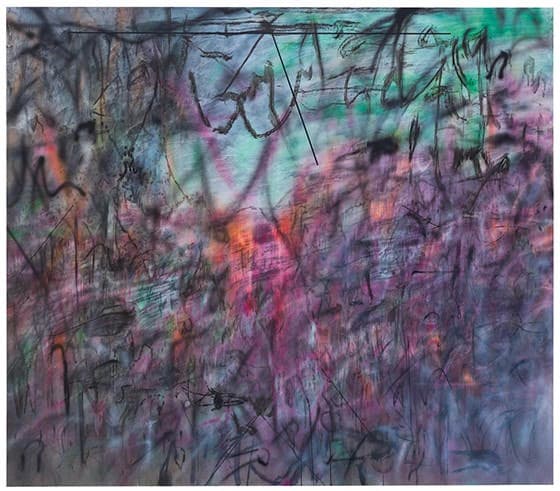
Julie Mehretu, Conjured Parts (eye), Ferguson, 2016 Conjured Parts (eye), Ferguson links disembodied anatomy with a site of violence and political strife. This painting began with a blurred photograph of an unarmed man with his hands up facing a group of police officers in riot gear, which was taken during the protests that followed the fatal shooting of Michael Brown in Ferguson, Missouri.
Late fascism as a mode of crisis management: An Interview with Şebnem Oğuz
In this interview, Şebnem Oğuz describes the concept of late fascism that differs not only from neoliberal authoritarianism and right-wing populism, but also from classical fascism. Rather than classical fascism which stabilizes itself through institutional closure, late fascism governs through permanent crisis, reorganizing accumulation around war, racialized violence, internal colonialism, and coercion. Drawing on and reworking the insights of Nicos Poulantzas and Alberto Toscano, Oğuz maps how capitalist states increasingly fuse ideological and coercive apparatuses, turning police, borders, and militarization increasingly into instruments of accumulation. From the global rise of the far right to Turkey’s war economy and the "peace process" regarding Kurdish question, she argues that fascism today is less a break with liberalism than a restructuring of capitalist statehood under conditions of stalled expansion.
What would it mean, then, to build an anti-fascist strategy adequate to this conjuncture— one that links anti-colonial struggle, feminist and ecological movements, and class politics against a regime that thrives on fragmentation and managed violence?
Şebnem Oğuz is a retired professor of political science and peace academic based in Ankara, Turkey. Her work centres on late fascism, with a particular focus on its articulation with contemporary imperialism and changing state forms. She has recently translated Albert Toscano's book Late Fascism into Turkish.
Understanding late fascism
Melehat & Ali: Concepts such as neoliberal authoritarianism, right-wing populism, and fascism are frequently invoked to explain contemporary social relations. How do you understand the relationship between these concepts?
Şebnem: The relationship between neoliberal authoritarianism, right-wing populism, and fascism can best be understood by situating all three within the problem of governing capitalism, that is, within the forms and practices of the capitalist state. Historically, the capitalist state has never been purely normative in the liberal sense. From its inception, it has combined a normative state operating through liberal legality with a prerogative state capable of arbitrary decision-making and coercion. Although capitalism is often theorized as resting on a separation between the economic and the political, this separation has been merely formal. Capitalism emerged through primitive accumulation and colonial domination, grounded in dispossession and expropriation carried out through racialized violence. In this sense, fascism, understood as racialized violence mobilized to secure property relations, was not an external negation of liberalism but a constitutive possibility embedded within capitalist statehood itself.
In moments of capitalist crisis, this violence moves from the margins to the center of state power.
Seen from this perspective, fascism should be understood as a specific response to capitalist crises, though not every crisis produces fascism. If we consider the three major crises of capitalism, the crisis of 1929, the crisis of the 1970s, and the crisis of 2008, we see that only the first and the last generated fascist trajectories. The crisis of 1929 produced classical fascism not only as a response to underconsumption or the search for new markets, but also as a strategy to defeat strong revolutionary working-class movements. In this context, racialized violence was integrated into the mode of rule itself.
The crisis of the 1970s followed a different path. Capitalist states sought to resolve it through neoliberal globalization. Accumulation was reorganized internationally, relying primarily on market mechanisms rather than systematic extra-economic coercion. This required an authoritarian but still “ordinary” and predictable legal order, one that disciplined labor, strengthened economic state apparatuses, and restricted democratic intervention without abandoning formal legality. Neoliberal authoritarianism thus rested mainly on market-mediated discipline, even as racialized inequalities persisted. During this period, right-wing populism emerged as a political strategy that constructed an antagonism between “the people” and corrupt elites while claiming to restore popular sovereignty.
The 2008 crisis exposed the limits of revalorization through expansion. As accumulation became increasingly stalled, capital turned more directly toward extra-economic coercion and racialized violence. War, dispossession, extractivism, border regimes, and sanctions became central mechanisms of accumulation. This shift signals the emergence of late fascism as a mode of crisis management.
Today, all three phenomena coexist. Neoliberal authoritarianism has not disappeared, but it no longer provides the dominant framework through which capitalist states manage the crisis. Right-wing populism continues primarily as a political strategy, yet it is increasingly mutating into explicitly fascist forms of leadership. And even where neoliberal authoritarianism persists institutionally in some contexts, it now operates within a broader structural movement toward late fascism, which increasingly defines the general trajectory of capitalist rule.
Late fascism: crisis management rather than regime coherence
Melehat & Ali: In your recent work, you conceptualize the current conjuncture as late fascism. How does this relate to existing theories of fascism, and why did you move from a predominantly Poulantzasian framework toward Alberto Toscano’s approach?
Şebnem: My turn to the concept of late fascism is not a break with Nicos Poulantzas. I continue to rely on his core insight that the central analytical axis of the capitalist state lies in the relationship between ideological and coercive apparatuses. Just as the circuit of capital structures Marx’s critique of political economy, the configuration of ideological and coercive apparatuses structures Marxist state theory.
What has changed is the historical conjuncture. The form of fascism we confront today differs both from what Poulantzas conceptualized as authoritarian statism and from the classical fascism he analysed as an exceptional state form. Poulantzas developed the concept of authoritarian statism to analyze a period in which accumulation was reorganized through market mechanisms under neoliberal globalization. Authoritarian statism named an ordinary capitalist state form in which executive power was strengthened, democratic intervention narrowed, and coercion intensified selectively, while formal legality and predictability remained largely intact. In this configuration, coercion functioned primarily to secure the accumulation politically rather than to organize it directly.
In his analysis of classical fascism, Poulantzas addressed an exceptional state form arising from a deep political crisis and the need to defeat organized working-class movements. Fascistization appeared as a process unfolding through stages, culminating in the stabilization of a fascist regime. Violence was central, but it was institutionalized within a relatively coherent and durable state architecture.
Late fascism is therefore neither intensified neoliberal authoritarianism nor classical fascism repeated under new conditions. Its specificity lies in governing through a permanent crisis. The current crisis of accumulation renders coercion structurally entangled with it. This entanglement destabilizes the ordinary/exceptional distinction that is central to Poulantzas’s framework. Coercion ceases to function as an episodic response to crisis and instead becomes a generalized condition of rule. This shift alters the nature of the state. Coercive apparatuses cannot be analysed primarily as instruments of political repression. Police, military, judiciary, and intelligence agencies increasingly function as apparatuses of accumulation, organizing extractivism, dispossession, sanctions, and border regimes.
At the same time, late fascism does not stabilize itself through institutional consolidation. Unlike classical fascism, it operates through crisis management rather than regime coherence.
It is here that Alberto Toscano’s intervention becomes indispensable. Toscano insists that the capitalist state has always been structurally dual and demonstrates how domination is actively differentiated across race, gender, sexuality, and colonial relations within the same political order. These are not latent tendencies awaiting activation under exceptional circumstances, “seeds” to be germinated in Poulantzas’s terms, but continuously deployed mechanisms of rule. Toscano thus helps us grasp how fascist dynamics can intensify without producing the institutional closure characteristic of classical fascism.
While Toscano does not develop a full theory of coercive apparatuses restructured as accumulation apparatuses, his conceptualization of late fascism as a crisis regime opens the space necessary to extend Poulantzas’s state theory. In particular, Toscano foregrounds internal colonialism and racialized differentiation, dimensions that remain underdeveloped in Poulantzas’s analysis of fascism and imperialism. His approach makes it possible to analyse how exposure to violence is unevenly distributed within the polity itself, and how this differentiated rule can intensify without stabilizing into a consolidated fascist regime.
In sum, Poulantzas’s theoretical tools forged to analyse neoliberal authoritarian statism and classical fascism cannot simply be applied unchanged to a conjuncture in which accumulation is increasingly organized through coercion, in which stability is not the outcome of fascistization but its absence, and in which the boundary between the ordinary and the exceptional is increasingly blurred. Toscano’s late-fascism framework provides the conceptual leverage to redraw the map of the state under these conditions, without abandoning Poulantzas’s core insight that the state must be analysed through the shifting configuration of its ideological and coercive apparatuses.
Gender, race, nature, and the working classes in late fascism analysis
Melehat & Ali: What contribution does the late fascism analysis make to our understanding of the relationship between gender, race, nature, and the working classes?
Şebnem: Late fascism analysis reshapes our understanding of the relationship among gender, race, nature, and the working classes by shifting attention away from stable identities or coherent class subjects, and toward the everyday, crisis-driven operations of capitalist power.
In the contemporary conjuncture, these relations are no longer articulated through the formation of a hegemonic social bloc or a unified working-class subject, but instead operate through fragmentation, substitution, and simulation.
The working class reappears not as a collective political agent rooted in relations of production, but as a racialised and gendered pseudo-class, most visibly in the figure of the “white working class”, which functions ideologically as a substitute for the absence of class organisation. Race does not simply intersect with class here; it provides substance to an otherwise hollowed-out notion of class, actively blocking any transition toward class politics. Gender is central to this process insofar as this pseudo-class is anchored in a nostalgic image of the white, masculine Fordist worker-citizen, making authoritarian masculinity a silent but structuring condition of contemporary class imaginaries.
From this perspective, identities cannot be treated as separate analytical domains, since race and class have always been historically co-constituted, particularly in contexts such as the US. Capitalist state under permanent crisis operates through the differential management of racialised segments of the working class via policing, incarceration, surveillance, and legal rightlessness, while gender shapes how coercion is lived, embodied, and unevenly distributed. Racialized and gendered populations encounter fascistic forms of control as ordinary conditions of social life, long before these mechanisms are generalised across society as a whole.
The same logic extends to nature, which is fully integrated into crisis management rather than treated as a secondary issue. Ecological destruction, dispossession, and extractivism are not unintended side effects, but central to an authoritarian mode of governance that treats land, resources, and populations as expendable. Crisis is administered without utopian or future-oriented horizons, such that nature appears as a background of managed damage and sacrifice, where environmental devastation is normalised as a condition of capitalist survival.
More broadly, fascism is grasped here as a selective deployment of coercion in which freedom is not abolished but redefined in racialized, masculinised, and proprietary terms, as the freedom to dominate, exclude, and extract. Class fragmentation is governed through racial and national hierarchies; solidaristic, reproductive, and collective forms of life are displaced by ideals of virility, competition, and risk; and ecological destruction is rendered ordinary rather than politicised. Struggles over nature, reproduction, and the body are part of the same political economy: ecological crisis, racial panic, and gender panic function together as attempts to restore order by projecting systemic contradictions onto vulnerable bodies and populations. What this analysis ultimately contributes is an understanding of gender, race, nature, and class as interconnected techniques through which capitalist crisis is governed preventively, in everyday life, and without the promise of social transformation.
Capitalist states reorganized coercion
Melehat & Ali: The following questions concern the analysis of fascism within the context of global dynamics. Firstly, what insights can be provided by the rise of the far-right in Europe, right-wing governments in the USA and Latin America, and the war in the Middle East?
Şebnem: A global analysis of fascism requires moving beyond nationally bounded explanations or a narrow focus on democratic erosion. Drawing on Toscano’s concept of late fascism, the rise of the far right in Europe, right-wing governments in the US and Latin America, and the war in the Middle East can be understood as interconnected expressions of a single global conjuncture: a phase of capitalism marked by prolonged crisis, imperial restructuring, and the normalization of violence as a mode of accumulation.
Toscano’s framework is distinctive because it does not conceptualize fascism primarily as the erosion of liberal democracy. Rather than concentrating, as liberal analyses often do, on juridical backsliding, constitutional decay, or threats to middle-class norms within individual states, Toscano foregrounds the relationship between fascism, state violence, and war.
Fascism is not defined by what it does to liberal institutions, but by how capitalist states reorganize coercion when accumulation can no longer be stabilized through expansion, social compromise, or hegemonic class projects.
A central insight of this approach is that accumulation increasingly depends on the violent reassertion of property relations. Here, Toscano draws on W.E.B. Du Bois’s notion of the counter-revolution of property. Du Bois showed that Black emancipation in the post–Civil War US posed a threat to established property relations, and that this threat was met through organized racial terror. Toscano generalizes this insight to the present conjuncture: violence is a constitutive element of accumulation itself, increasingly embedded in everyday forms of governance.
From this perspective, the rise of the far right in Europe appears as an internal front of coercive accumulation. Anti-immigrant policies, border militarization, and racialized security regimes function materially to discipline labor, redistribute risk downward, and withdraw social rights through force. Far-right politics thus normalize authoritarian practices that secure property against social claims under conditions of austerity, stagnation, and declining legitimacy.
Similarly, right-wing governments in the US and Latin America govern crises by intensifying policing, incarceration, paramilitarization, and extractivist expansion. In these contexts, fascism is often misrecognized as a threat to liberal sensibilities, focused on figures such as Trump, while its core operations, including mass deportations, racialized violence, and imperial genocide, are displaced from view. The defence of property increasingly takes precedence over democratic legitimacy, with governance organized around emergency, punishment, and selective coercion.
War in the Middle East represents the most explicit expression of this late fascist logic. War is a central mechanism of accumulation under conditions of crisis. Military violence, territorial control, and large-scale dispossession directly reorganize property relations and secure imperial interests, while war zones function as laboratories whose techniques of coercive governance circulate back into metropolitan centres. Taken together, these developments reveal a global imperial regime in which capitalism confronts crisis through the violent reassertion of property.
Turkey and the construction of social peace
Melehat & Ali: Upon returning to Turkey, it is evident that a peace process is underway between the state and the Kurdish Liberation Movement. In your opinion, what are the conditions for achieving social peace under late fascist conditions? In this context, how would you evaluate the relationship between the CHP (Republican People's Party) – which has been marginalised and criminalised for some time because it is the main opposition party and a candidate for power – and the DEM (Peoples' Equality and Democracy Party) – which is in talks with the government due to the "peace process" regarding Kurdish question), in terms of a united front against fascism?
Şebnem: Under late fascist conditions, social peace cannot be conceived as reconciliation or institutional reform. Late fascism operates through the structural fusion of war, dispossession, and accumulation under permanent crisis. Peace, within this regime, is necessarily provisional and selective: a tactical suspension of violence that enables the reorganization of accumulation before coercion reappears in renewed forms. War and peace thus function as complementary mechanisms of rule for dominant classes, redistributing violence across populations and territories rather than abolishing it.
From this perspective, social peace can only be constructed as a collective praxis that confronts the accumulation regime producing war in the first place.
This framework is essential for understanding both the current “peace process” in Turkey and the relationship between the CHP and the DEM Party. The decisive actor is not opposition party maneuvering but the Turkish war state itself, structured as a sub-imperial, internal-colonial formation. Over the past year, this state has recalibrated its regional role through the restructuring of the war economy, with the marginalization of the CHP arising not merely from political rivalry but from its deliberate exclusion from the material circuits of the war economy. At the same time, the DEM Party’s engagement in talks has been portrayed by the state as proximity to power, without amounting to dismantling the colonial war order. As a result, a politically misleading optic has emerged: one that casts DEM as aligned with the state while presenting the CHP as the primary anti-fascist force.
Breaking this optic requires redefining fascism not as institutional erosion but as Turkey’s internal-colonial war state. Only within this frame can the defense of democratic institutions be meaningfully connected to a strategy that confronts war, property relations, and colonial violence simultaneously.
Melehat & Ali: In the context of the “peace process,” how should left-wing social forces position themselves against late fascism, and what counter-strategies are required?
Şebnem: If late fascism is understood as a regime that governs through accumulation by war and coercion, an effective anti-fascist strategy in Turkey must rest on two articulated foundations. First, it must adopt an explicitly anti-colonial perspective centered on the Kurdish question. Internal colonialism is the structural core of the Turkish state and the organizing principle of its war economy. For this reason, the struggle for peace is central to anti-fascism.
Second, opposition to the war economy must be organized through a broad alliance linking labor, feminist, LGBTQ+, youth, and ecological movements. Peace cannot be reduced to temporary normalization that opens new zones of capital accumulation; it must be redefined as a collective praxis that disrupts the fusion of extractivism, militarization, and accumulation. Defending land, water, energy, housing, and social reproduction against state–capital violence provides the material basis for such an alliance. Feminist struggles expose the war regime’s grip on social reproduction; LGBTQ+ movements fracture fascist control over bodies; youth movements confront militarization and enforced futurity; and ecological struggles challenge the territorial foundations of war-centred accumulation.
Developments since 6 January underscore the urgency of this strategic orientation. The renewed assault on Rojava lays bare the peace–war dialectic at the heart of late fascism. It demonstrates that the Kurdish movement is continuously repositioned as a conditional and revocable subject within a permanent war regime. Under these conditions, the task of the left is to make the defence of Rojava a constitutive dimension of anti-fascist struggle within Turkey itself. Rojava is not an external issue; it is a frontier of the same war regime that structures repression and dispossession inside the country.
This strategic orientation does not exclude institutional actors such as the CHP, but it cannot be subordinated to them. The CHP’s opposition remains largely confined to the language of democratic erosion, leaving the state's war–extractivist political economy fundamentally intact. The role of left-wing social forces, therefore, is not alignment but sustained pressure: forcing institutional defences of democracy to confront the internal-colonial and sub-imperial foundations on which the regime rests. Only through such a reorientation can an anti-fascist front emerge that is capable of generating its own political temporality beyond electoral cycles, grounded in anti-colonial struggle, social reproduction, and renewed internationalist solidarities.
Melehat & Ali: Finally, is there anything else you would like to add, aside from the questions?
Şebnem: Thank you for the opportunity to share my views in this interview.
Interviewees
Authors

Melehat Kutun
Melehat Kutun is working at the University of Kassel on her research project "The Reshaping of Abortion Politics in Turkey: Understanding Islamic Right-Wing Populism Through the Differing Experiences of Three Groups of Gynaecologists". Her publications focus on contemporary politics in Turkey, critical state theories, critical gender studies and abortion politics, and forced political migration.

Ali Yalçın Göymen
Ali holds a PhD in Political Theory from Istanbul University. His current research investigates the Turkish regime's strategies for appropriating the commons and constructing false alternatives, producing subjectivities suited to a new model of accumulation: commons-based accumulation.