Mapping authoritarian inscriptions and resistances at UCL's campus
Workshop Report: From "(Post)neoliberal Fascization" to "From the Picket Line" — Conversations on the (Post)neoliberal University
Theory & ResearchIn mid-June, IRGAC was supposed to meet up with colleagues from Goldsmiths, University of London, and University College London to reflect on the materialities of contemporary fascisms — but the crude reality of another round of neoliberal attacks on universities and the ensuing labour struggle at Goldsmiths crossed our plans. In accordance with the situation and in solidarity with our comrades at Goldsmiths, we decided to change the workshop's focus to the role of universities and knowledge in today's context of authoritarian restructuring and fascization, both as material sites in which the capitalist, colonial order is deeply inscribed and as sites of struggle and resistance.
The workshop, supported by IRGAC and conceived and organised by Thibaut Vaillancourt and Gustavo Robles as a space of dialogue between artists, facilitators, activists and academics, started from the premise that contemporary fascisms cannot be fully understood by analysing the spectacular images and discourses they produce. Rather, we should look at them as a force that is built, inhabited and experienced in everyday life. Fascisms have a material existence: they occupy spaces and reshape cities, inscribe themselves on bodies and intimate relationships, operate through borders, and circulate through images and imaginaries. Confronting them, the organisers argued, requires first exposing and grasping this materiality.
The original idea was to hold the event at Goldsmiths, University of London, over two days, bringing IRGAC researchers into conversation with Goldsmiths colleagues around a set of guiding questions: How are fascist bodies configured in the digital age? What renewed tasks for internationalism are emerging today? In what ways can neoliberalised subjectivities be challenged through counter-affects and new artistic sensibilities in the face of technofascism and broligarchic power? Rather than a purely theoretical exercise, the workshop sought to link critique with counter-strategy, fostering collective reflection on how an antifascist response — rooted in spaces, images, devices, and affects — could be conceived to address the current crisis.
Background: The Goldsmiths Strike
In the course of organising the workshop, a major industrial dispute broke out at Goldsmiths. Staff represented by the University and College Union (UCU) escalated action in response to "Future Goldsmiths," a new restructuring plan aimed at cutting roughly £22 million from the budget — the third such round of job cuts in five years, putting more than a fifth of the workforce, some 269 posts, at risk. After an initial marking and assessment boycott launched in late April, the university announced it would deduct 100 per cent of pay from staff taking part, a move the union described as a lockout; UCU responded by calling an indefinite strike from 8 June 2026. The dispute drew wider attention as a signal of the deeper financial and political pressures reshaping British higher education, including years of consultancy spending and successive restructurings that critics argue have hollowed out established departments and research traditions.
Faced with this situation, the organisers were unwilling to hold the event at Goldsmiths as planned, both because of the practical difficulties this posed and, above all, out of a wish not to undercut the ongoing union struggle. It was decided to reconceive the workshop's format in solidarity with the strike rather than cancel it outright. For this purpose, our colleague Erol Sağlam kindly secured a space at UCL, allowing us to hold a reformulated version of the event. This shortened workshop was dedicated to reflecting on the relationship between knowledge production and the university, and on the neoliberalisation of academic evaluation, workloads and demands, turning the Goldsmiths conflict itself into a lens through which to think about IRGAC's own position within a neoliberalism in crisis.
The Event
On the first day, Professor Matthew Fuller opened proceedings with an account of the neoliberalisation, defunding and marketisation of English universities, taking Goldsmiths as a witness case: how the university has become part of a wider process of marketisation managed by consultancies and non-academic bodies, now driving programme closures, staff redundancies and the erosion of established research traditions.
This was followed by a panel on Neoliberalism and New Subjectivities, in which Professor Jo Littler presented her work "Meritocracy and the Hard Right," analysing how the notion of 'merit' has recently been redeployed by the right, fusing neoliberal narratives of meritocracy with far-right sentiment.
The day closed with Professor Lisa Blackman's presentation of her recent book, Grey Media: Psychopolitics of Deception, reframing gaslighting as a form of "gray media" that operates across political discourse, information warfare and generative AI, linking psychological abuse to wider authoritarian and technofascist dynamics.
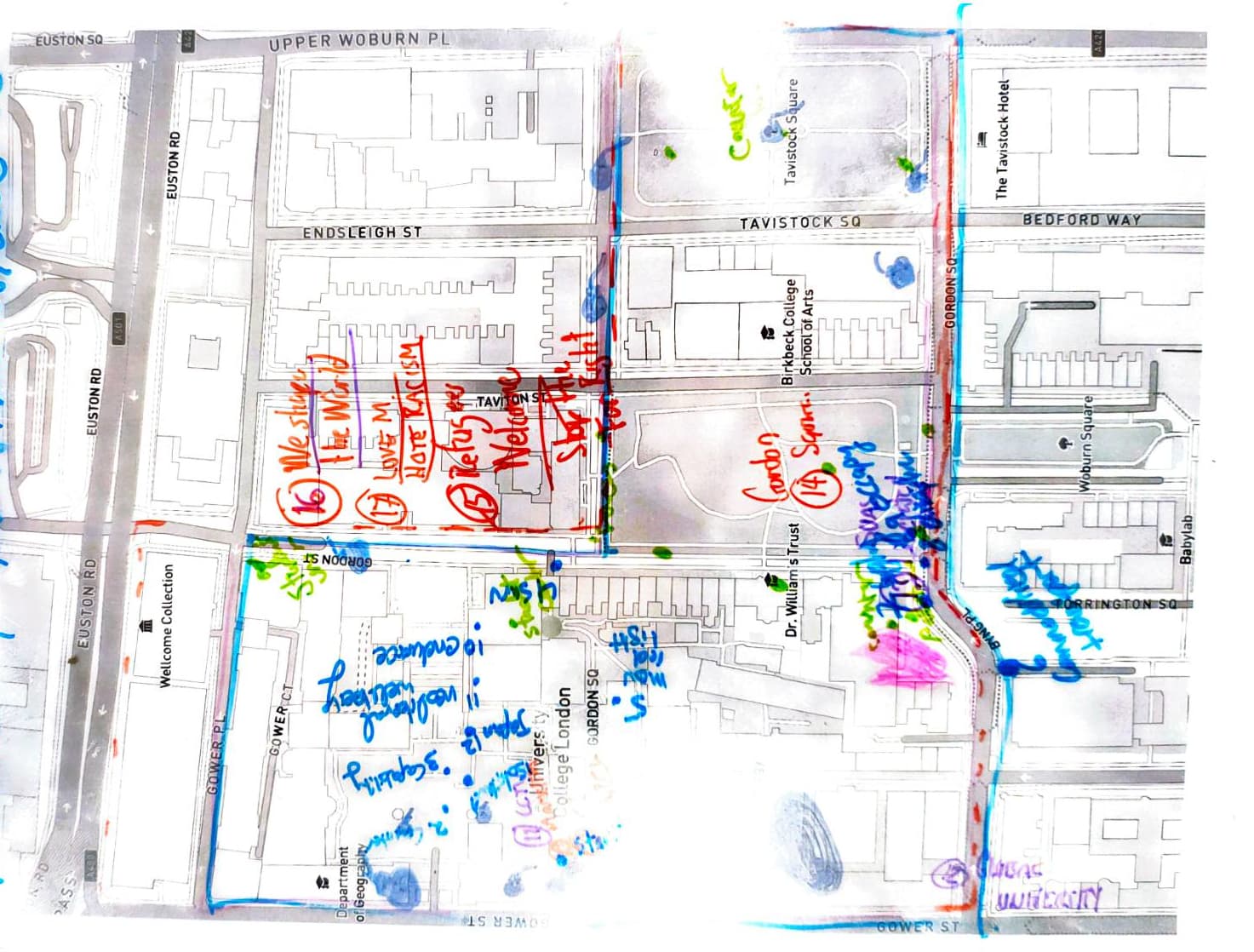
The second day took a different methodological turn, centred on a countercartography session facilitated by Leonardo Aranda (medialab, Mexico) and Tuline Gülgönen (kollektiv orangotango, Germany). Cartography was proposed as a concrete, situated counter-strategy, in which the map serves as a tool for contesting the organisation of spatial imagination and material urban settings. Rather than treating cartography solely as an object of analysis, the session revalued it as a political tool for constructing meaning and experience, and included a walking exercise across the UCL campus that mapped traces of coloniality and authoritarianism, as well as practices of insubordination and spatial resignification. This workshop also served as a discussion of concrete tools for map-making that can be replicated in other political and academic practices.
Reflections: South–North Dialogue and International Solidarity
Many IRGAC members come from universities, territories and struggles of the Global South that often feel — or are thought to feel — distant from those of the Global North. The discussion space built in London over these two days served as a platform for thinking through those connections, and the Goldsmiths conflict, far from being a mere backdrop, became a productive point of contact: a concrete instance of the same neoliberal and authoritarian dynamics that IRGAC studies elsewhere, now unfolding within one of the institutions co-hosting the workshop.
Holding the event in a reformulated format, rather than cancelling it, was itself a small act of international solidarity — an attempt not to let institutional crisis foreclose the dialogue, while also refusing to proceed as if nothing were happening. For IRGAC, this exchange is likely to continue in a future workshop closer to the original idea in Berlin as well as through a publication project currently in process.
The organisers thank Matthew Fuller, Lisa Blackman and Jo Littler at Goldsmiths for their generosity in reformulating this collaboration amid a difficult moment for their institution, Erol Sağlam for securing a classroom at UCL, and all speakers, discussants and participants for their contributions.
Authors

IRGAC
The International Research Group on Authoritarianism and Counter-Strategies (IRGAC) aims to zoom in on the regional and global interconnections of authoritarian capitalism and reactionary populism and place them at the centre of scholarly debates.
Gustavo Robles
Gustavo Robles researches the subjective dimensions of neoliberal governmentality, the political economy of digital capitalism, and the intersections between authoritarianism, democracy, and platformization.