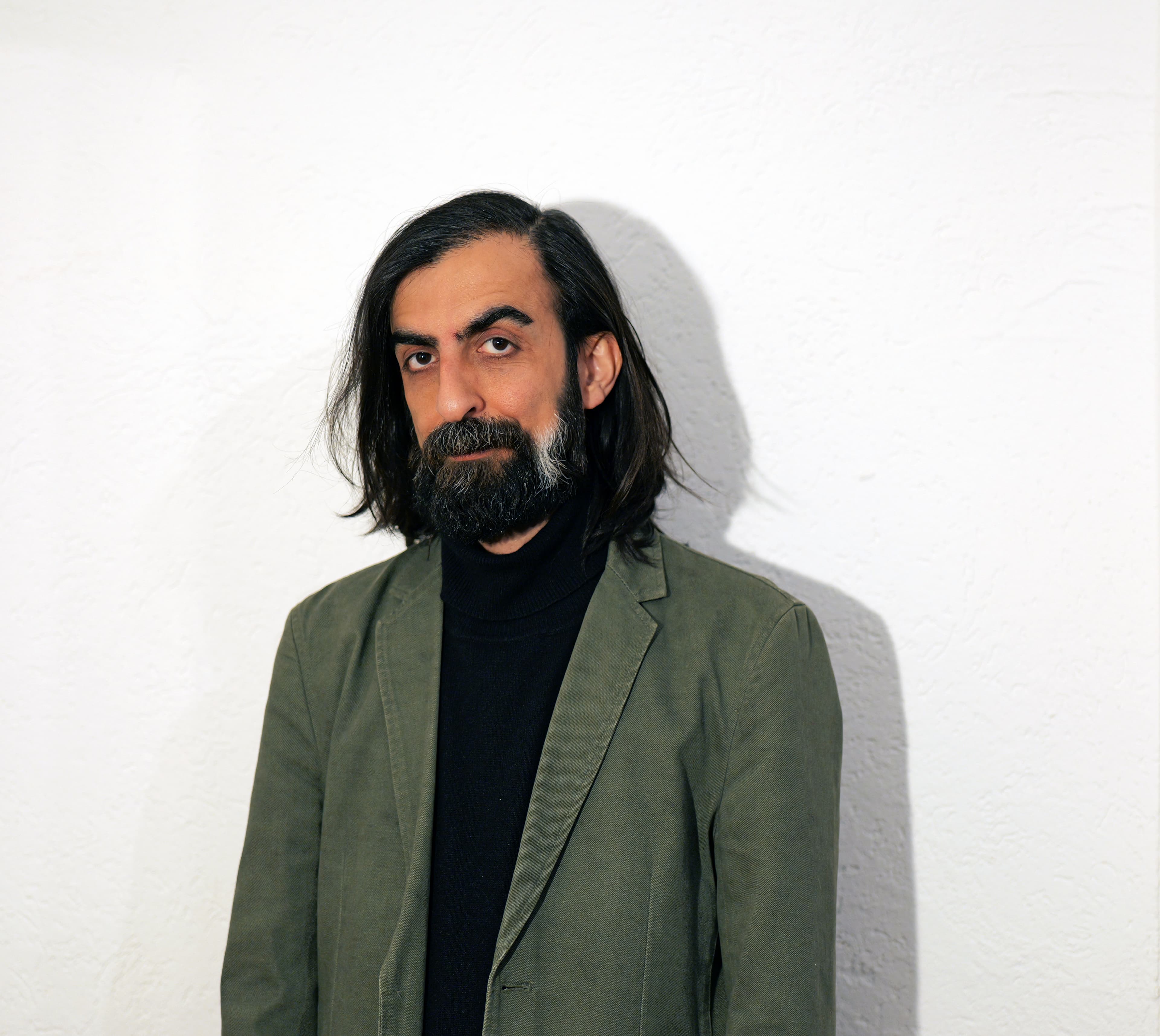
Nader Talebi
"We should recognize the agency of the Iranian regime and the people who oppose it": Nader Talebi
InterviewIran is going through dramatic times and tectonic shifts, from the Jin, Jiyan, Azadî movement in 2022 to the massive mobilizations at the turn of the year, the brutal January massacre, and the illegal war waged by Israel and the US. In this interview, Nader Talebi reflects on the waves of uprisings that express a fight to reclaim life against a regime that enforces gender apartheid and destroys the means of reproduction of life. He discusses the Islamic regime and its tensions between a neoliberal state project and a messianic Shia imaginary, and what the January massacre has changed: the end of hope that revolution can come from within, and a drift toward nihilistic politics. And he insists on what connects the mobilizations of the last years — a politics of life, cross-ethnic solidarity, and a revolutionary tendency that makes any dictatorship hard to sustain.
Interview with Nader Talebi
Melehat: Mainstream discourse sees Iran almost exclusively as an “Islamic regime”, a label that focuses on one dimension: religion. Could you give us a broader picture of what kind of political project this regime actually is, and how we should understand its class basis and political economy?
Nader: I think the Islamic regime cannot be explained only as an “ideological” regime, nor solely from a class perspective. Of course, a class perspective allows us to learn about its policies or the relation to different social groups, but the totality of it cannot be reduced to a single class or a coalition of classes.
The Islamic regime was born out of a revolution. This implies both a rupture with what was before, and also a claim to change the whole world. After the revolution in 1979, the economy went through a process of nationalization that also targeted the historical bloc with close ties to the Shah. But with the beginning of Khamenei's era at the end of the 1980s, we have extensive neoliberalization, which affected different groups of people and allowed the regime to bring forward a dependent capitalist class. And to understand the political economy of the regime, oil is also a major factor. It is, at least in theory, in control of the state, which diverts it towards certain groups and supports its rule by buying loyalty and covering corruption.
But in my opinion, it is more fruitful to think about this regime in terms of the political imaginaries that it puts forward, the hegemonic visions that govern both its internal affairs and its relations with proxy forces across the Middle East. That political vision is a messianic Shia one. Nevertheless, we have to understand that the imperial tendencies in the state in Iran predate the revolution. They have their roots in the formation of the national state out of the Persian Empire in the early 20th century. In fact, the Shah himself was eager to be the gendarme of the Middle East and to expand Iran's influence referring to the old imperial histories. But the 1979 revolution provided a much better, more flexible and effective political imaginary for bringing forward these imperial tendencies, mixing it with a revolutionary understanding of Shia messianism. And it helped the regime to formulate a base which goes cross classes and secure support beyond its borders.
Melehat and Ali: You described the regime as driven by a messianic Shia political imaginary rather than class interest. But how does it actually hold together institutionally, and what are the internal tensions within the regime?
Nader: The Iranian state has two concurrent momentum: a "national state" momentum embodied by the president, and a "revolutionary Islamic" momentum embodied by the supreme leader, that is not bound by national borders. The national state aspect pushes for inclusion in the international order through privatization aiming to create a “normal” bourgeoisie, while the revolutionary aspect, mainly through the Revolutionary Guard and its associated economic networks, operates beyond Iran's borders, reinforcing a messianic Shia political imaginary and its expansive political project. This duality enables the regime to appeal to diverse groups: it offers a vision of justice and anti-imperialist resistance that resonates across classes, while using the state's oil wealth and neoliberal policies to co-opt or control different social factions. But there is also a constant struggle between these momenta, a tension within the Iranian state as the revolutionary momentum actively destroys state institutions, be it in Iran, Yemen, Lebanon or Iraq, toward challenging the established world order, which is dominated by the Imperialist forces.
Melehat and Ali: Let us turn to the question of resistance. Iran has seen several waves of uprising over the last 15 years, with the latest massive protests that were brutally repressed in January this year. What drives these uprisings, and what has the January massacre changed?
Nader: What unites the intensifying waves of uprisings is that they try to reclaim life in Iran — the life that is being impacted by an oppressive regime that enforces gender apartheid, and a neoliberal state that destroys the environment, the society and the means of reproduction of life. The protests and the massacre in early January this year were the peak of an era of demonstrations that appeared with different formulations of the demands over time. In 2009, people's dissent was mostly expressed or narrated as a quest for democratic rights with a focus on the main cities and, in particular, Tehran, the capital; in 2017 and 2019, huge demonstrations happened mostly in the margins of the country with heavy emphasis on the need for rupture. In 2022 the Jin, Jiyan, Azadî (Woman, Life, Freedom) momentum clearly brought forward this vision that we can be together in a different way — not in the Shia, masculine centeralist way that the state envisages our togetherness as a nation. We can relate to each other in a care-oriented, or sisterhood relation if you like. This was a new national imagination in a rupture with the history of Iranian nationalism before and after 1979 Revolution.
But in reaction to those protests, the regime has shown that there is no limit to its violence.
In the massacre they killed everyone, regardless of their political opinion or background. And maybe this ends the vision that there is a possibility to change this oppressive regime. Even if we come in masses, even if we come with our children to the streets, they kill everyone: children, women, young, old. After about 17 years of demonstrations, this might be perceived by many as the end of hope for revolution from within.
I want to stress two important consequences of this. The first is that this leads more people to support former Crown Prince Reza Pahlavi, even though they are not monarchists. The rationale behind this is that bombing and killing the regime would allow us to come to the streets and make the revolution. In my opinion, it is out of desperation that more and more people share this vision — it seems as the only remaining path. And regarding the second consequence: Woman Life Freedom revolutionary momentum had a positive, life oriented imagination. Today, out of the oppression of that momentum and the mass killings, we have an increasingly nihilistic kind of politics. We moved from a revolution of care in 2022 to "I don't care what will happen, I just don't want you to enjoy killing us". It's a strange moment. We have people in Iran and in the diaspora who are happy about the attack. How can you be happy to see your country being bombed? I connect that to the fact that the continuity of the regime has become the dominant fear for many people in Iran, considering its long history of atrocities. And that overshadows the fear of war and its possible consequences.
Ali: Does that mean that after the massacre, everything is reduced to a nihilistic politics of death?
Nader: No. All around Iran, after the massacre, people were dancing in the graveyards of those who had been killed. We have this tradition in parts of Iran that if a young person dies, you do a sort of wedding celebration at the funeral, as if this life owes you at least one happiness. And this has now become a broader tradition, not just for the young, but for anyone who was killed by the regime. People dancing in graveyards, to say: we don't want you to see us sad and enjoy killing us. This is something extraordinary. So I am asking myself, why would people do something so strange, and what drives them to it? And it is connected to resistance: we are celebrating life, even in the graveyards, against a regime that turns everything into a graveyard. The mullahs are the chiefs of death; that is the only thing they have a monopoly on, the afterlife, like any religious authority.
What we see is a fight about life, a fight to get it back.
Melehat: The January massacre happened in the context of the war with Israel last summer, and is now followed by the US and Israeli attacks. How do you understand the relationship between war, protests, and the massacre?
Nader: The political imaginary of this regime has always had a final war on its horizon, translated into Shia messianism: the rise of Mahdi will bring justice to the whole world. And this war has always been both internal and external. Just look at how they manage cities in Iran: the urban planning is entirely organized around the question of how to suppress a possible revolt. There is always this perspective of security, and there is always the perspective of preparing for the final war with Israel and the US. War has been a blessing for this regime. It mobilizes its supporters and allows the regime to do things that would normally face resistance. It is very hard for people to come to the streets during a war to protest, as we saw in the summer and see now, while regime supporters are comfortable in the streets every day.
At the same time, the regime framed the massacre as a continuation of the war last summer with Israel, a Mossad plot. This framing allowed the regime to mobilize to kill people in that number. They said this was a continuation of the war, that those who came to the streets were soldiers of Israel on the ground. And this framing was reinforced from the other side too: Trump told people to go to the streets, help was on the way, while Netanyahu was the only figure in the Middle East speaking positively about the uprising, which is ridiculous, and a hijacking of Iranian suffering to justify genocide. So both sides connected the war and the uprising in Iran.
What is disappointing and sad is to hear the regime propaganda repeated by leftists around the world, as if people in Iran have no reason to be angry with the regime and want a revolution. As if they were just idiots deceived by Mossad, while our leftist white saviours sit here and save us by telling us that this is all an Imperialist plan. As if we, the Iranian people, don’t deserve better in Iran. Instead, we should recognise the agency of the Iranian regime and the people who oppose it.
Melehat: You mention the diaspora and international left. How do people in the diaspora relate to what is happening inside Iran, and how is their role for the movements in Iran?
Nader: I would not separate people in diaspora and people inside Iran as if they were two homogeneous groups — we have different political ideas both inside and outside Iran. Of course, the louder voices in the diaspora right now might be the monarchists and those close to the crown prince, but that is not representative. The difference is not really about being inside or outside Iran; it is about the conditions of demonstration and perceptions of urgency. In Iran, when you go to the streets, you do not ask each other which group you support. You are against the regime, they kill all of you, and you help each other. In the diaspora we have a lot of time to express ourselves and fight with each other. Perhaps there is less urgency to think about unity when you are not facing bullets.
But what connects diaspora and people inside Iran, beyond political divisions, is a growing sense of care and connectedness. Ten years ago, the narrative was: "You live abroad; you don't care about our lives in Iran." More and more, with the uprisings and particularly with Woman Life Freedom, that changed. People in diaspora started finding ways to contribute, to not just watch from a distance. More people are now engaged in demonstrations and politics abroad compared to 10 years ago. They are divided and fragmented in their politics, but united in their sense of connection with the homeland.
Melehat & Ali: What scenarios do you see for Iran? Is Pahlavi likely to play a key role? And what role can progressive forces play, both inside Iran and in the region?
Nader: Things are very liquid in Iran right now, so let me not try to foresee the future precisely but think through different scenarios. I don't see Pahlavi as a very likely scenario, because without boots on the ground, bombing alone won't produce the fundamental change they envisioned. But I also don't see any short-term democratic scenario. The severity of the situation — war, massacres, destruction, the possibility of civil war — makes it hard to imagine. What I see most probably is a reformulation of the government, either in a more reformist, nationalist direction or a more hardliner, permanently war-oriented one. That is not yet clear.
What is clear is that almost every scenario is very bad for the left and progressive forces in Iran. And this is not only because of the war or because Israel and the US are backing the crown prince. It comes very much from the failures of the left itself. They lost the momentum of Jin, Jiyan, Azadî in 2022 and failed to form a front that could relate to people and offer a credible vision of change. There is a tendency on the left in Iran to be arrogant toward the people: "we know the theories, you don't have class consciousness, come to the party and we will make you revolutionaries". This moralistic, top-down attitude is one of the reasons the left is so weak and unpopular. There is real hatred toward the left among large parts of the population. We come across as those with no real scenario, nothing concrete to offer, yet always find ways to blame people for not meeting our expectations of a “proper” revolution.
I am not optimistic about the political opposition, particularly the progressive forces. But I am still optimistic about the Iranian people. And what makes me optimistic is, first, the way people relate to each other in difficult times, something we saw in Jin, Jiyan, Azadî, but also during earthquakes and wildfires. I think of Kurdish activists who went to northern Iran, saying we came to help; of people in Baluchistan going to the streets for people in Kurdistan, saying we will not let you be alone with your pain. And second, the revolutionary tendency in Iran. This is a nation of uprisings. We had two revolutions in 1905 and 1979, and Jin, Jiyan, Azadî was a revolutionary moment too.
These histories make it hard for any dictatorship, crown prince or Islamist to maintain order.
Despite imperialist interventions, despite the genocidal state of Israel manipulating the situation, and despite a regime with no limits to its violence, there are still people fighting for life and caring for each other, and there is still the possibility of a rupture with the present in Iran. And that is what the whole Middle East needs. Netanyahu, Erdogan, Ben Salman, Iran, they all want to make a new Middle East, a rupture in an oppressive direction. Against that, there is this revolutionary spirit from below that we can see in the Arab uprisings, in Gezi, in Women's Life Freedom, in Rojava, and in many other initiatives and moments that care about a very different future. These struggles influence each other. We Middle Eastern peoples are learning in a very painful way, through ecological catastrophes, wars, displacements, and the whole counter-revolutionary international cooperation in our oppression, and a lot more, that our lives are much more connected than we consider in our political strategies. We always say: No one is free until everyone is free, and this is something very true for the present Middle East.
Authors

Ali Yalçın Göymen
Ali holds a PhD in Political Theory from Istanbul University. His current research investigates the Turkish regime's strategies for appropriating the commons and constructing false alternatives, producing subjectivities suited to a new model of accumulation: commons-based accumulation.
Sara Cufré
Sara Cufré is a feminist researcher from Argentina. She holds a degree in Political Science and a PhD. in Social Sciences (Universidad de Buenos Aires)
Melehat Kutun
Melehat Kutun is working at the University of Kassel on her research project "The Reshaping of Abortion Politics in Turkey: Understanding Islamic Right-Wing Populism Through the Differing Experiences of Three Groups of Gynaecologists". Her publications focus on contemporary politics in Turkey, critical state theories, critical gender studies and abortion politics, and forced political migration.