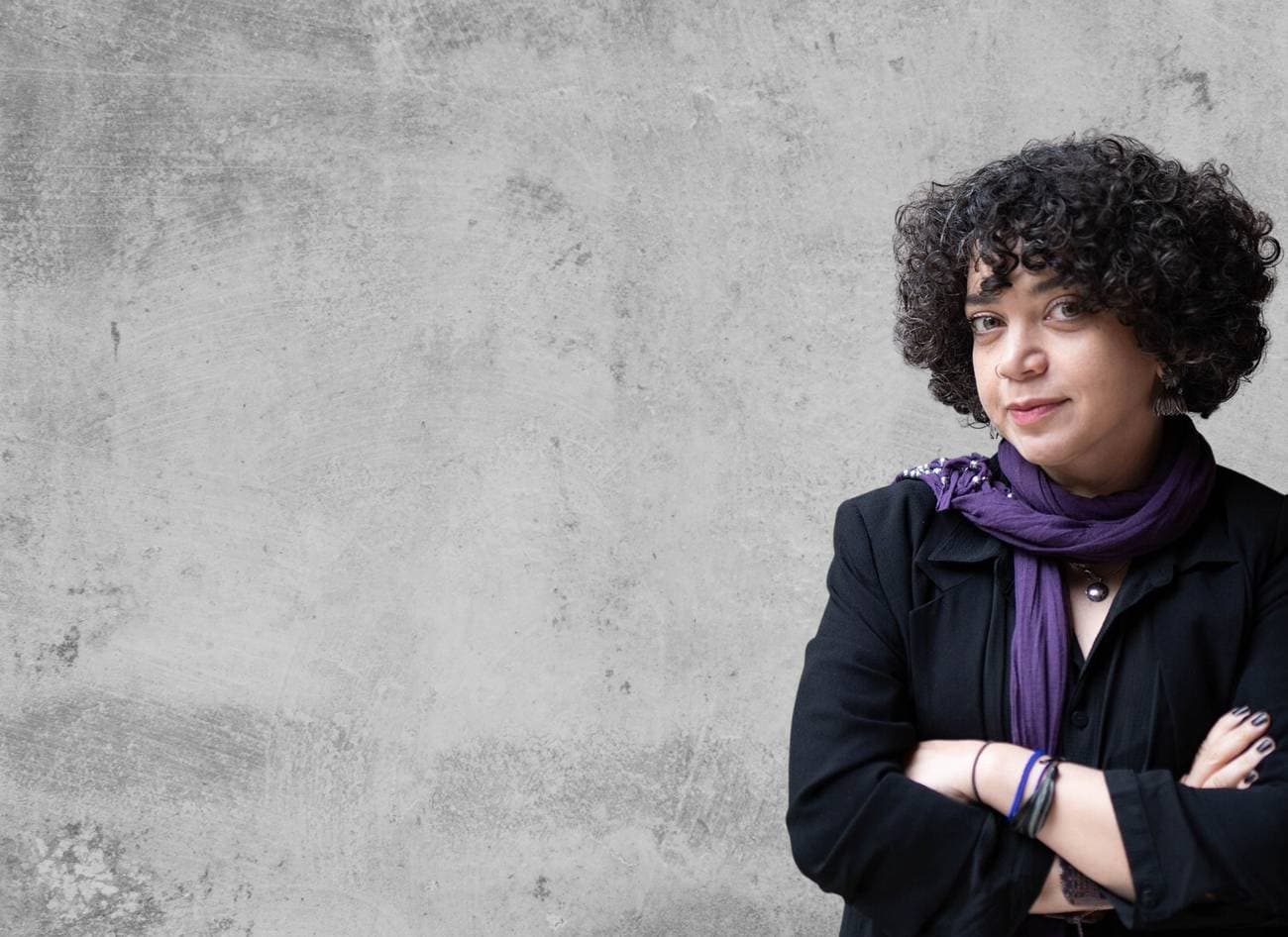
Firoozeh FarvardinCredits: Irene Graf
Iranian Feminism, Between War and the Regime
InterviewThe war in Iran has reshaped the political landscape that emerged from the 2022 uprising: it has strengthened the Islamic Republic, given new momentum to monarchist right-wing forces in the diaspora, and narrowed the space for an autonomous feminist politics. In this interview, Iranian scholar Firoozeh Farvardin examines how to oppose the regime without supporting foreign intervention, and how to sustain networks of care, resistance, and internationalism from below.
In September 2022, the killing of Mahsa Jina Amini—a 22-year-old Iranian Kurdish woman who had been detained in Tehran by the so-called “morality police” for allegedly violating mandatory hijab regulations—triggered one of the largest uprisings in Iran since the establishment of the Islamic Republic. Under the Kurdish slogan “Jin, Jiyan, Azadî” (“Woman, Life, Freedom”), protests against state control over women’s bodies quickly evolved into a broader challenge to the regime, its repressive apparatus, and the forms of social and political inequality that run through Iranian society.
Nearly four years later, the landscape has changed dramatically. State repression dismantled activist networks, imprisoned militants, and forced many activists into exile. At the same time, the military offensive carried out by Israel and the United States reshaped the political terrain: it enabled the Islamic Republic to present itself as a defender of national sovereignty, strengthen narratives of internal unity, and deepen the criminalization of those who oppose the regime. Meanwhile, monarchist and right-wing sectors, particularly active within the diaspora, gained visibility through a discourse that links regime change to foreign intervention and seeks to establish itself as the legitimate voice of the Iranian opposition.
In this interview, conducted by Carmín Rios Fukelman and Miranda Hochman and originally published in Spanish in Nueva Sociedad, Firoozeh Farvardin—an Iranian feminist scholar currently affiliated with the University of Vienna and an associate researcher with the International Research Group on Authoritarianism and Counter-Strategies at the University of Potsdam, and affiliated with the Berlin Institute for Empirical Research on Integration and Migration (BIM)—reflects on the place of feminism in a context marked by internal repression, war, and struggles over who speaks for the Iranian opposition.
This interview was originally published in Spanish as El feminismo iraní, entre la guerra y el régimen.
Much of the international coverage of the Iranian crisis is organized around a geopolitical lens: the United States, Israel, the Islamic Republic, Russia, China, regional powers. Within that framework, the voices of Iranian feminists are often pushed aside. What is lost when Iran is viewed only from that perspective? And how are the attacks by Israel and the United States interpreted by those struggling inside the country?
The narratives we encounter in the media and in much of public debate are almost always geopolitical. I am not suggesting that this dimension is unimportant. Of course it matters. But when people talk about this region, and Iran in particular, the conversation becomes almost entirely captured by that framework. The focus is on states, alliances, military balances, and strategic interests. What disappears is Iranian society itself.
I am interested in beginning from a different place: looking at what is happening inside Iran through the experiences of ordinary people. This means asking how domestic politics and external events relate to one another. They are not separate spheres.
War, sanctions, military threats, and state repression are deeply interconnected.
For those living in Iran, the question is not only which international actor gains or loses power, but what possibilities remain for organizing, resisting, speaking out, and imagining a different life.
The first thing to understand is that war functions as a counterrevolutionary moment. Since 2016, Iran has experienced a cycle of revolutionary movements, reaching a peak in 2022 and another important moment in January 2026. Like many other Iranian feminists, I believe that war blocks the most progressive dimensions of that cycle. Whether the Islamic Republic wins or loses, war is a blessing for the regime because it allows it to suppress the opposition movement and gain legitimacy both inside and outside the country.
What is happening outside Iran is deeply concerning. In certain circles that see themselves as progressive or left-wing, the regime is beginning to be viewed almost automatically as a legitimate force simply because it confronts the United States and Israel. People forget that only a short time ago there was a massacre in which thousands were killed within a matter of days. Now the Supreme Leader and military commanders who were unlawfully assassinated are being praised, while it is overlooked that they themselves were also responsible for killings and repression.
Meanwhile, inside Iran, executions continue every day. Many people are arrested on accusations of espionage, opposing the war, or supporting the United States and Israel. To be clear, I believe the country was illegally invaded. Whether or not I agree with the regime is irrelevant. It was an illegal invasion. I cannot accept the assassination of a foreign country’s leader without consequences. But that is one problem. The other is that the regime uses that aggression as a pretext for even greater repression.
Nationalist sentiments are also growing. That does not mean everyone supports the Islamic Republic. However, many people begin to feel that in the face of an illegal war they should support the Iranian state as the protector of the nation. I do not agree with that position, but I understand how polarization pushes some people to believe that supporting the state is less harmful than supporting foreign intervention.
I say this not only as an academic living outside Iran, but as a feminist who remains closely connected to what is happening there and who continues, as much as possible, to work and conduct research with Iranians and on their experiences. The missing voice in the public sphere is that of those seeking a third path. That voice exists, both inside Iran and in the diaspora. It comes from people sustaining grassroots networks, practicing politics of care, and rejecting both the regime and the war. Yet these voices receive very little media attention. They are often the same people trying to rebuild or keep alive the networks that emerged during the 2022 uprising.
The Islamic Republic has been preparing for war for years. It has missiles, weapons, and a militarization program that kept running despite international sanctions. But it never prepared to protect its own population: it built no shelters, there is still no shelter for ordinary people, and there is no long-term plan for a war economy. The economic recession now under way is extremely severe. In that context, it is these same groups and circles that were politicized back in 2022 who provide concrete support at the level of everyday life. They keep trying to sustain daily life for ordinary people, for workers, and for political prisoners—to support them and to give people inside Iran a voice, despite everything.
A major problem now is that the internet has almost disappeared. It is extremely difficult to stay in contact. There is an internal, national internet, but the connection to the outside world has been cut off. A special, very expensive VPN exists, but only a small number of people—those who can afford it—are able to access it. This makes it very hard to know what is actually happening inside Iran. But from the news that comes out from time to time, through tweets or fragmented messages from comrades, it seems that people are still trying to keep these cells and communities alive and to work out what they can do next. It is, however, a mode of minimum survival. There is almost no political positioning happening right now.
In 2022, the opposition movement against the regime seemed to be marked by a strong feminist and emancipatory character. Now, however, monarchist, militarist, and openly pro-intervention discourses appear to be gaining ground. How has the landscape changed between the 2022 uprising and the more recent mobilizations, both inside and outside Iran?
When I say that the regime’s legitimacy has increased, even within Iran, I do not mean that it has become popular. There is still very strong opposition. Many ordinary people continue to protest against the Islamic Republic. There are even people who say they want war because living under the regime is worse than war. I do not want to judge them or deny their agency. But I also believe we need a concrete understanding of what war actually is. Now that war is taking place, fewer people openly say that they prefer war to the Islamic Republic. The situation is extremely polarized.
The new monarchist wave and support for war should be understood as a counterrevolutionary reaction. The monarchist far right already existed before. It was present during the 2022 uprising as well. As in any broad social movement, not all participating forces were progressive. But in 2022 monarchists did not possess political or discursive hegemony. Feminist voices, marginalized communities, and progressive positions had much greater capacity to shape public meaning.
By January 2026, however, monarchists had gained considerably more space. This is due, first of all, to repression. Many of the people who had been active in 2022 were either imprisoned or had left the country. But it is also explained by the support monarchist groups receive from Israel, the United States, and Saudi Arabia. It is visible through satellite television channels, social media, TikTok, and large-scale efforts aimed at promoting the idea that monarchical restoration is the only real alternative to the regime.
That position has become more popular. The language and rhetoric of the January 2026 protests were not the same as those of 2022, either inside or outside Iran.
It is clear that the discourse was much less feminist.
At the same time, unlike other observers, I would not simply label that movement “fascist.” I do not see it that way. I believe there was continuity with the cycle of protest that began in 2022 after the killing of Mahsa Jina Amini. The evidence lies in those networks, in the participation of progressive forces in the streets, and in the forms of organization that persisted. Yet, especially outside Iran, the discourse that succeeded in organizing the political scene was the monarchist one.
This affects how the war is interpreted. From the outside, someone might conclude: “The Iranian people are mostly monarchist and therefore want war.” That interpretation helps justify an attack on Iran. Monarchists certainly exist and continue to have a presence. But after months of seeing that war does not bring regime change but rather the destruction of the country and the collapse of the state, I believe many people are beginning to understand something else. War is not directed solely against the Islamic Republic. It makes life inside Iran impossible. For that reason, I think that many people, both inside and outside the country, are becoming less supportive of this type of intervention.
One of the consequences of war, beyond destruction, trauma, and the impossibility of sustaining daily life, is that the Islamic Republic now possesses greater power. But it is also wounded. And that may make it even more dangerous. Tragically, ordinary people lose regardless of the regime’s fate. Before the invasion, thousands were killed through state repression. Now, with the invasion, there are also thousands of deaths and hundreds of children killed.
What I keep asking myself is why it has become so difficult to mourn all of these people. Politically, it has become almost impossible to say, “I oppose the killing of these people,” without someone responding, “Then you support the other side.” Perhaps the Iranian case is an extreme expression of something more general, but this is the condition of our world: a brutal polarization in which human lives matter less than the political camp one is expected to belong to. It is a very sad story.
In this context of extreme polarization, how do feminist movements intervene? What forms of organization and care survive when the regime represses, war blocks political action, and the loudest voices in the diaspora seem trapped within the binary opposition between the Islamic Republic and foreign intervention?
Describing what is happening inside Iran today necessarily involves a degree of speculation. Information is extremely limited. Everyone seems to be taking sides within this polarization. Yet those who are actually doing something inside Iran are civil society activists—many of them feminists—and networks devoted to sustaining everyday life that were already active in different cities. They amplify the voices of prisoners, people facing death sentences, and affected families. They help the wounded and the imprisoned, share information, and provide support.
That is where real politics is taking place. Not among those outside Iran calling for war, nor among those claiming to represent the Iranian people through diaspora media. It is being carried out by these activist groups, many of them feminist in practice even when they do not explicitly identify themselves as such.
At the moment, people are largely in survival mode. Some groups are raising money to support workers who lost their jobs because many factories were destroyed. Iran also has a huge number of platform workers. That work has disappeared as well. It is difficult to imagine how many people have become unemployed. And there is no state plan to address the situation. As a result, these groups are beginning to create small alternative economies, mutual-aid structures, and ways of producing and sustaining themselves collectively.
Another example is assistance for those wounded during the January 2026 uprising. Many could go to hospitals because they risked being arrested or even killed there. Some still have pellets or small bullets lodged in their bodies. The people helping them are members of groups formed during the Jina uprising, networks that still know one another, remain connected, and continue to mobilize when needed.
Politically, however, these networks currently lack an articulated public voice.
First, because internet access has been cut and they cannot communicate. Second, because outside Iran, the loudest voices belong either to circles close to the regime or to various monarchist currents.
Women's rights have often been used to justify foreign intervention in the Middle East: the notion that the West must “save” women from Islamic extremism. At the same time, the Islamic Republic attempts to appropriate certain feminist demands and use them for its own propaganda. How do these competing appropriations of women’s rights operate today?
Whenever war occurs, a particular form of hegemonic masculinity re-emerges: the heroic man who protects the nation. Many cisgender men, including some who identify as left-wing and have recently aligned themselves with the Islamic Republic, frame the war in exactly these terms. They say, “We are protecting our territory just as we protect our women.” That image is present in Iran, but also in many other places.
We know that wartime conditions tend to increase gender-based violence and domestic violence. I do not have direct statistics on what is currently happening in Iran, but reports and testimonies suggest that this increase in violence is indeed taking place.
The Islamic Republic also instrumentalizes the issue of the hijab. Through years of struggle and sacrifice, women won certain forms of autonomy over their bodies. Today the regime attempts to claim: “We do not have a problem with the hijab.” At some pro–Islamic Republic demonstrations, women without hijab can even be seen participating. But this is propaganda. It is aimed at international audiences and seeks to demonstrate that women support the Islamic Republic. In other words, the regime takes rights won through women’s struggles and uses them for its own purposes.
Something similar happens from the outside. We saw Israel writing “Woman, Life, Freedom” on missiles, attempting to appropriate that struggle. It is a battle of narratives. Both sides seek to appropriate not only women’s rights but also Indigenous, anti-colonial, and anti-racist struggles.
That saddens me deeply. In the Iranian context, people who oppressed the Iranian people, Iran’s Indigenous peoples, Kurds, Baluch communities, minorities, and women are now transformed into heroes of anti-colonial and anti-imperialist struggles outside Iran. The logic seems to be: the enemy of my enemy is my friend. Once again, the lives of people on the ground are forgotten.
The savior narrative exists on both sides. Yet I think it is used less than it was twenty years ago during the wars in Iraq and Afghanistan. After everything that happened, including the Taliban’s return to power, the United States seems to have partially abandoned the language of “exporting democracy” or “women’s rights” as a central justification. Today the rhetoric is much more openly about economic interests, oil, business, and preventing Iran from becoming too powerful. The idea of bringing democracy or liberating women still appears, but it no longer occupies the central place it once did.
In Latin America, we are also witnessing a resurgence of aggressive masculinities, often linked to the precarization of life. How do you understand the relationship between social powerlessness, reactionary masculinities, and the new right?
It is a reaction to powerlessness. All of us, in one way or another, feel that we lack agency. But the responses to that lack of agency differ. The far right, as well as some Iranian monarchist sectors, offer a very appealing promise: they tell people that they can regain power, become part of a winning project, that they are doing something meaningful. That promise is not real, but it produces very concrete effects.
Progressive sectors, by contrast, are losing the battle when it comes to offering a tangible promise about the future. Very often, the future appears as something overly abstract, as mere speculation. Some people might think we should abandon it altogether and focus only on the present. But in order to overcome fear and live a normal life, people need the promise of a normal life. We cannot ask people to sacrifice everything for an unknown future or for future generations. People need something concrete for the present and the near future.
We have greatly underestimated that need. We bear responsibility for not taking it more seriously. We need to think about how to make our projects more attractive to ordinary people, to people who simply want to live better, feel secure, and have some degree of control over their lives.
You recently moderated a conversation titled “Fascist Pleasures,” about the affective dimension of authoritarianism and the far right. In Latin America, this struggle also plays out in everyday life: in the face of precariousness, debt, and declining expectations, promises of individual autonomy proliferate—from entrepreneurship to financial speculation, cryptocurrencies, or simply the idea of “doing something” with one’s money. The right seems better able to understand the desire to regain control over one’s life. What should the left learn from this struggle over emotions and the sense of power?
I think this is a central issue. We are living through a very difficult moment for people in Iran, but we should not treat it as an exception. In recent years, we spoke about the genocide in Gaza as if it were something happening “over there,” in an exceptional place. Now something similar is happening with Iran. But this is the logic of the contemporary world: a regime of war and a process of fascization advancing on multiple fronts. We need to understand that this can reach all of us.
For that reason, we should not treat Iran as an exception, nor should we ask only how it is possible that part of the Iranian diaspora—or people inside the country—might support war or accept the destruction of their own territory. That tendency exists, but it is not uniquely Iranian. There is a destructive desire present across the world: people know that they too will be harmed by what they desire, and yet they desire it anyway. This is not disconnected from the rise of post-fascist and far-right movements. Nor is the extreme polarization of politics something unique to Iran.
I do not want to end on an overly pessimistic note. As I said, this entire movement of war and oppression is a counterrevolutionary attempt to prevent the waves that emerged in 2016 and 2017 from producing something genuinely new. But struggles for life continue. They experience interruptions, advances, and defeats, yet they continue. My hope is that something can emerge from them.
At the same time, I know that a purely national solution cannot succeed. All the authoritarian states in the region were frightened by what was happening in Rojava, in Kurdistan, in Iran since 2022, and during the second wave of the Arab uprisings. Despite their differences, those processes had much in common. And those states helped one another suppress the region’s progressive movements.
After so much mobilization around the world, I feel that very little has changed in the lives of people living under direct violence and ongoing genocide.
That forces us to rethink political strategy. Taking to the streets and mobilizing en masse no longer means the same thing it did ten years ago. It does not function in the same way, nor does it produce the same effects, because we are living through a different configuration of relations between states and societies. I am not saying we should abandon the streets, but street mobilizations alone are no longer enough.
Now, with war, everything is worse. The discourse of the most radical far right has become normalized. People can openly speak of the annihilation of entire civilizations without facing consequences. In that context, popular feminisms possess a more nuanced understanding and a broader repertoire of action than simple protest, because they connect everyday life with politics. But even feminism needs renewal. Feminist movements are also experiencing something of a recession. Not everywhere—Kenya, for example, still has a very powerful movement—but generally speaking, we are no longer in the same moment we were a decade ago, nor at the high point of the cycle that opened in Iran after the killing of Mahsa Jina Amini.
That is why I believe we all need to rethink the ways in which we practice politics. If we are to find solutions, they will not emerge at the national level. The question is how to build a new internationalism from below. Feminist movements can play a fundamental role in that process. As Verónica Gago has argued, they possess a unique capacity to connect very different struggles. That remains a light at the end of the tunnel.
War, technological transformations, precarity, and the growing power of capital are rapidly reshaping capitalism. At the same time, many institutions once considered progressive now seem captured by reactionary dynamics. Do you see any space within this crisis for new forms of socialism, internationalism, or emancipatory politics? And what would you like Latin American feminists to know about Iranian feminisms today? What kind of solidarity or conversation is needed at this moment?
I believe this is a profound crisis operating on multiple levels. Among other things, war reveals that the United States no longer possesses the hegemony and power it once had. There is no guarantee of a bright future, but that does not mean every door is closed.
That is why it is important to foster conversations across different regions. Power structures try to make us feel distant from one another: Argentina and Iran, Latin America and the Middle East, cultures and religions supposedly separated by insurmountable differences. But the similarities are greater than the differences. We are connected by precarity, gender-based violence, the rise of authoritarian right-wing movements, the sense that we can no longer live this way, and the need to imagine different futures.
I would like to see a real and honest conversation with Latin America. In some progressive and left-wing circles, I see very little empathy for the people of Iran. Because the Islamic Republic confronts the United States and Israel, they conclude that the regime must therefore stand with the people. They interpret the situation as an anti-imperialist struggle, but they fail to see what is happening at the grassroots level.
Among feminists, I would say this problem is less pronounced, although it is not entirely absent. There is a different sensitivity because, through the politics of everyday life, it is easier to understand what is happening, despite all the cultural differences. All of us experience gender-based violence, and that alone should be enough to understand what we mean when we say that the current state structure is harmful to feminized bodies.
We need a form of solidarity that does not force a choice between the regime and the war. A solidarity capable of listening to those who sustain life, care for others, and resist from below. Opposing imperialism cannot mean closing our eyes to the violence of the Islamic Republic. And opposing the Islamic Republic cannot mean supporting the destruction of the country. That is the conversation we need.
Authors
Carmín Rios Fukelman
Holds a degree in Social Sciences from Humboldt University of Berlin and is currently pursuing a Master’s degree in Global Studies at FLACSO Argentina and Humboldt University of Berlin.
Miranda Hochman
Holds a Bachelor's degree in Social and Cultural Anthropology from the National University of San Martín and is currently a Master's student in the Global Studies Programme at Humboldt University of Berlin.