The Lost Innocence of Playing: Why games are becoming the new cultural battlefield between the far right and its opponents
Theory & ResearchVideo games and game cultures have become one of the far right’s most effective tools for gaining popularity among younger generations. Game cultures and gamers profoundly influence the current dynamics of social media networks, especially the so-called alternative web. GamerGate provided “a social media playbook” for the alt-right, proving how much power coordinated gaming communities could unleash. At the same time, a growing number of game designers are trying to produce games promoting anti-hegemonic, anti-capitalist, and anti-fascist narratives, making them crucial battleground for countering far-right views and reactionary historical narratives.
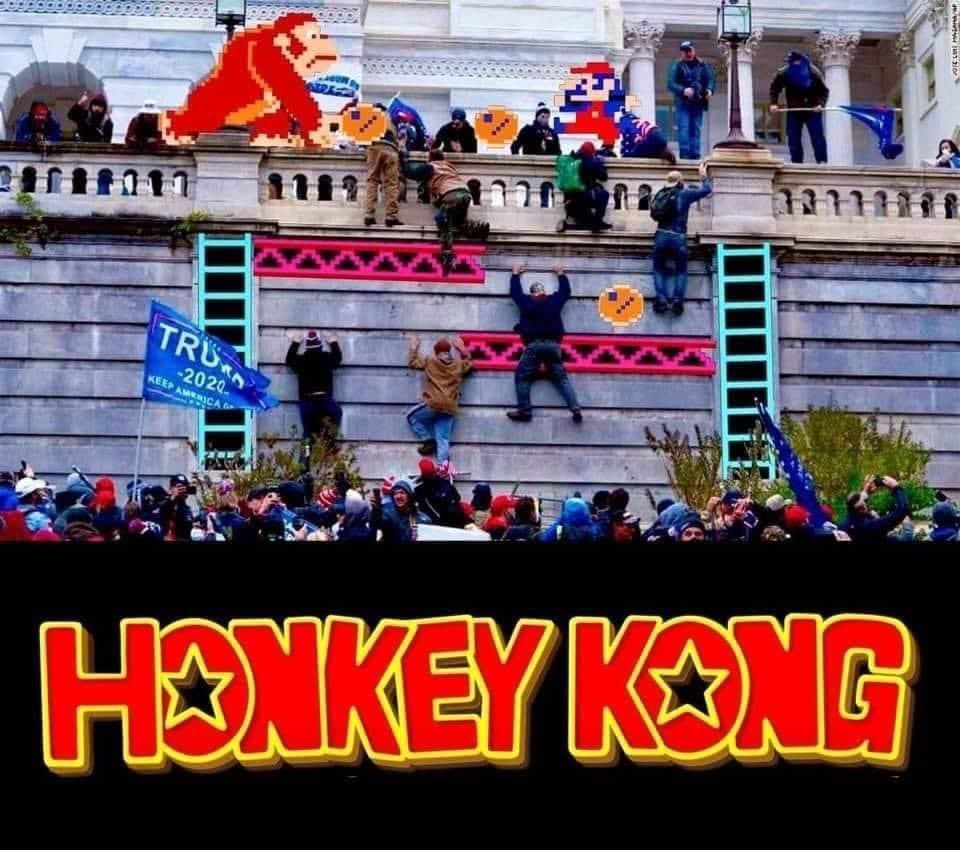
In her book Gaming Democracy. How the Silicon Valley Leveled Up the Far Right, Adrienne Massanari begins by discussing the assault on Capitol Hill on 6 January 2021 by a mob of extremists and members of conspiratorial movements protesting the election of Joe Biden as President of the United States.
Some days later, a meme began circulating on the web, portraying one of the scenes of the assault as the classic arcade video game Donkey Kong (1981), with the assailants pictured climbing the ladders in place of Mario, while Kong throws barrels at them. For Massanari, the meme encapsulates how “gaming culture has permeated all facets of American (and global) society”.
Even if they are still often treated as mere fun and not worthy of serious investigation: in recent years, games, and especially video games, have increasingly made their way into the news in relation to politics and warfare. This was recently the case with a video advertising the US bombing of Iran, which the White House published on Wednesday, March 4, 2026. The video mixed real images with footage from a very popular first-person shooter (FPS) video game, Call of Duty.
Almost two years earlier, on January 28, 2024, while the genocide in Gaza was unfolding, a rudimentary board game was apparently distributed among participants of the “Victory of Israel” conference in Jerusalem. The event gathered right-wing Israeli politicians and religious figures, with the aim of planning the resettlement of Gaza. The game was titled Build your home in Gaza!. From the leaked photos, the mechanics resemble those of classic games such as Risk!, with the board visually representing the map of the Gaza Strip divided into territories, their names written in Hebrew, and colored tokens used to occupy the different sectors.
There are plenty of reasons why we should pay more attention to what is happening in board games and, especially, video games. The video game industry is by far the most important entertainment industry. Its global revenues surpass those of movies and music combined, and reached $455 billion in 2024. As of 2026, more than 3 billion people actively play video games worldwide. The image of the player as a young, white, geeky man no longer matches reality, even if the industry itself still clings to an obsolete image of the ‘core player’. A growing number of women and people from the Global Majority play games, and an increasing number of game designers are trying to bring more diversity and pluralism — in terms of race, gender, and anti-hegemonic narratives — often re-imagining game mechanics for educational purposes.
And yet, board games and video games do not receive the critical scrutiny that other entertainment and cultural fields do. It is true that academic attention has grown in recent years, with “game studies” becoming a discipline of its own. But mainstream media offer no specific sections or regular coverage of games — even less so in the Global Majority — as they do for cinema, literature, or television. While I have met many friends from Southwest Asia and North Africa, including women, who play both video games and board games, gaming rarely becomes a topic of discussion the way other cultural products do.
Given their popularity, what happens in games is extremely relevant and their impact shouldn't be underestimated. And there are other reasons why we should talk more about games.
Games play a crucial role in the development of new technologies.
Nvidia, for example, began developing super-fast computer processors to serve the video game industry’s incessant demand for better graphics. Those processors paved the way for the advent of generative AI. And above all, game cultures and gamers profoundly influence the current dynamics of social media networks, especially the so-called alternative web.
But perhaps the most important dimension to scrutinize is how, over the last ten years, video games and game cultures have become one of the far right’s most effective tools for gaining popularity among younger generations.
Where the story begins: Bannon, IGE, and the hidden power of gamers
Among the millions of Jeffrey Epstein’s released emails, some revealed regular exchanges, dating from at least 2012, between him and Bobby Kotick, former CEO of Activision Blizzard (the production house of the open world video game World of Warcraft). The correspondence reveals Epstein’s interest in the capacity of video games as a tool for the education — or indoctrination — of youth. On May 2, 2013, he wrote: “Video games are already great at teaching. (...). Once kids catch on that you are trying to teach them something, they shut down. We have to keep the boobs and guns and profits. You see how much video games are making these days? F*** educational reform. We need education subversion!”. Some of the emails suggest that Epstein even wanted to purchase stock in Activision Blizzard.
Some years earlier, Steve Bannon — future strategist of the 2016 Trump campaign, who had a close relationship with Epstein — had also begun to make contact with the game industry and game cultures. If many business and political elites in the US understood the power of games, as Epstein’s emails prove, it was Bannon who learned how to harness it for his own political plans.
If we need to set a starting point for the story, it would probably be when Steve Bannon entered Internet Gaming Entertainment (IGE). The company was founded in 2001 by Brock Pierce, a digital entrepreneur with a past as a child actor. IGE gained notoriety for launching the first planned effort to create a larger business out of real-money trading (RMT) in open-world games (MMOs: massively multiplayer online role-playing games) such as World of Warcraft, Age of Conan, EverQuest, and others.
In these games, players gain experience and wealth with their avatars while going through quests and adventures and fighting monsters and other players. This requires money, skills, and, especially, time. The idea of selling objects (the magic sword is the classic example) to players who have money yet don’t want to spend too much effort acquiring them spread quite early, but before IGE it remained confined to the initiatives of single individuals or small networks. Brock Pierce was the first entrepreneur to see the opportunity to create a larger business, establishing a corporate retailer of the virtual.
The company built a chain of production and distribution that reached its golden age after 2004, when World of Warcraft was launched, soon attracting millions of subscribers. At one end of the chain, Chinese so-called “gold farms” employing hundreds of low-wage workers incessantly provided the currency and equipment many players craved. In the middle, freelance players were paid to pick up those goods and deliver them virtually to the buyers. IGE supervised the whole process, collecting its percentage. At its peak, the company’s RMT business reached $880 million per year.
In this context, Steve Bannon was asked to join the company’s board with the mission of transforming what was until then a gray market of virtual money exchanges into a more legitimate and serious business. He remained for six years, and while he didn’t succeed completely, he convinced his former employer Goldman Sachs to invest about $60 million in IGE.
Thanks to his involvement with IGE, Bannon came into contact for the first time with the world of gamers. He was deeply impressed by how players in World of Warcraft coordinated to boycott IGE’s affairs in the virtual world. Apparently, avatars of Chinese workers roaming around as elves and dwarves, retrieving swords and armor for profit, were seen by many players as disruptive to the fantasy atmosphere and the rules of the game. They began organizing spontaneously to fight IGE, flooding Blizzard with reports and using the game’s message boards to file complaints, thus contributing to the failure of IGE’s business.
Bannon saw in those collective actions something extremely valuable: the power that loose networks of individuals (mainly young white males) can express even without any shared ideological background or guiding leadership. As Brian Nuckols puts it, it was this experience that taught Bannon that “twenty-first-century political coordination often operates through technological platforms rather than physical assemblies and demands digital literacy and algorithmic strategy rather than consensus processes designed for smaller-scale interaction”.
#GamerGate
In political terms, the turning point and “opening salvo of the new culture wars” was GamerGate, which provided “a social media playbook” for the alt-right. GamerGate was a violent, misogynistic online harassment campaign that took place between 2014 and 2015 and mainly targeted women in the video game industry, such as the feminist video game critic Anita Sarkeesian and the video game developers Zoe Quinn and Brianna Wu.
Max Haiven, a scholar and game designer, later labeled this type of collective action as “playgrom”. Similarly to an actual pogrom, a playgrom takes the form of violent mob acts directed against minorities, but it is deeply embedded in game cultures and video-playing circles.
GamerGate emerged from the so-called “alternative web”: platforms like Reddit and 4chan, characterized by an ugly aesthetic and hosting subcultures based on common interests rather than personal networks. More importantly, these spaces afford partial or full anonymity, and often embrace an extreme form of techno-liberalism and free-speech absolutism, i.e., very lax moderation policies.
These elements made these platforms a perfect environment for far-right rhetoric, racist and homophobic views, and online harassment to thrive.
However, GamerGate was completely new in terms of scale and coordination. Behind it were groups of (mostly anonymous) far-right activists, trolls, and especially game fans, in particular those who considered themselves to be the ‘core players’ of the industry: young, white, cisgender men who perceived their status as threatened by the diversity some game designers were supposedly trying to impose.
The intersection of platforms like 4chan and Reddit with games takes place on multiple layers. Not only are these spaces extensively used to debate games, with many subgroups focusing on them, but they are also structured as a kind of game, with members gaining points on the basis of their contribution to the community. Moreover, these communities often express forms of “ludic fascism”, as trolling and politically incorrect sarcasm are presented as a way of playing. As Konstanze N’Guessan explains in a study on far-right groups in Germany, when controversial statements are criticized, or a victim of online harassment reacts, the answer is “but it was only a joke”. Gaming culture tends to frame these behaviors as not having consequences in the real world, while the victims of harassment are mocked as “non-player characters” (NPCs).
GamerGate showed that game fans could effectively play the mechanisms of social media networks to their advantage, launching coordinated harassment attacks, trolling and meme campaigns, and doxing, i.e. releasing private data, against their targets. The effects were devastating, and set the industry back years in terms of diversity and pluralism. Even if these events gradually faded away, their impact cannot be overstated. GamerGate offered a playbook for similar campaigns in the following years, intimidated many ‘progressive’ designers, and above all proved to groups of young, angry, alienated white males that they did indeed constitute a specific class of players — and taught them how much power they could unleash.
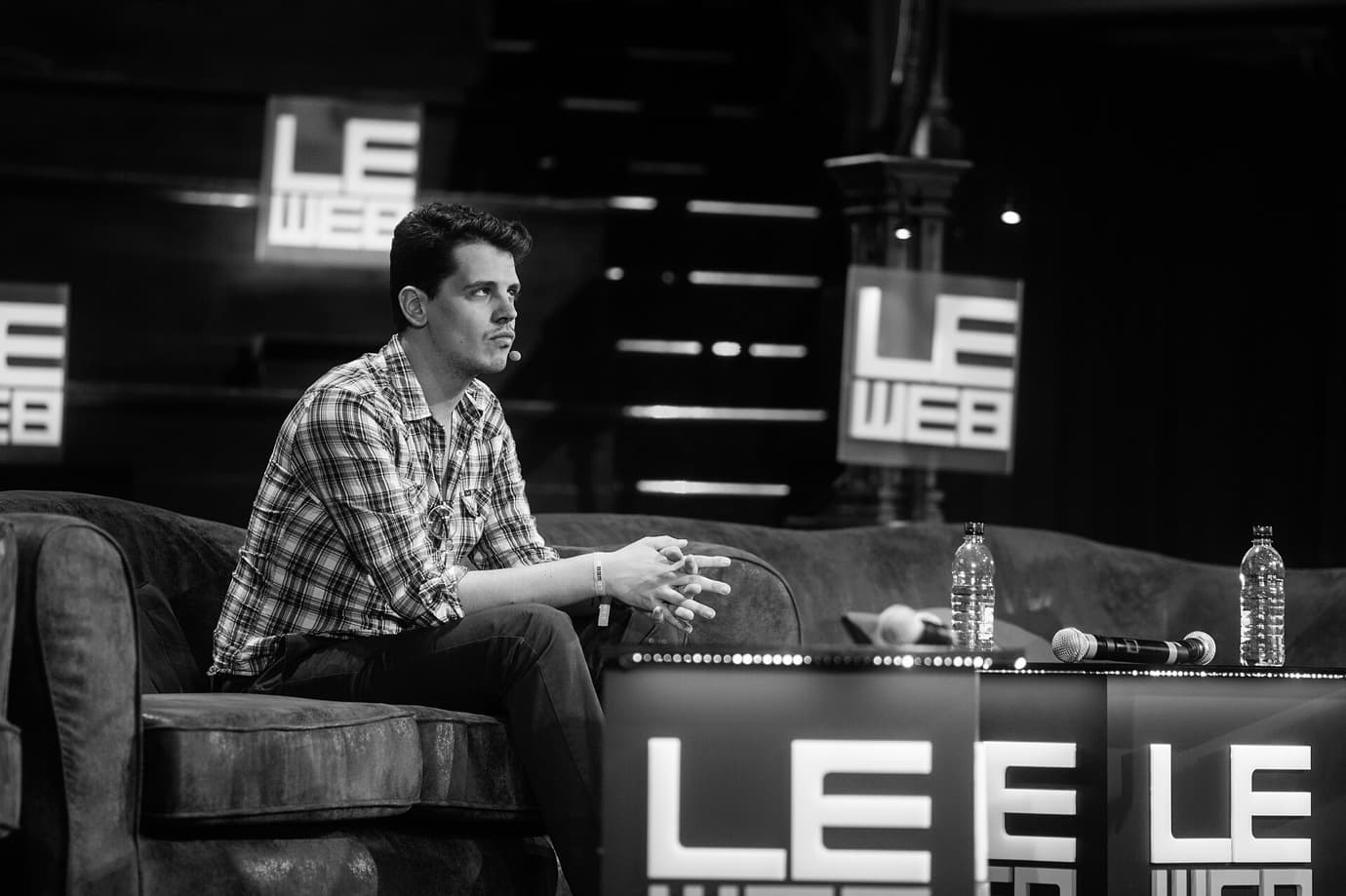
All they needed was someone capable of ushering them out of the alternative web and into the mainstream. In 2012, Steve Bannon had become the executive chairman of Breitbart News, with the idea of transforming it into the “platform of the alt-right”. Under his guidance, the outlet opened the door to recruiting the alienated gamers of the alternative web. Donald Trump’s run in the 2016 elections offered the occasion to connect these gamers with the classic alt-right operatives orbiting the magazine. To this end, Bannon recruited to Breitbart News Milo Yiannopoulos, a British gay tech blogger and troll who had also played a prominent role in GamerGate. As Joshua Green describes in detail in Devil’s Bargain (2017), Bannon identified Yiannopoulos as the ideal figure to draw gamers into his political strategy. “I realized Milo could connect with these kids right away”, he said. “You can activate that army. They come in through GamerGate or whatever and then get turned onto politics and Trump”. Soon, communities on 4chan and Reddit were coordinating to support Trump in the 2016 election campaign.
The fascination of reactionaries with games
If far-right movements could quite easily turn gamers into a “killing machine”, as Bannon put it, it is also because of the pre-existing link between video game cultures and reactionary politics. The fascination sometimes originates from the settings of many of these games: medieval fantasy, ancient and modern wars, the Roman Empire, and so on. These settings provide cultural imaginaries based on a nostalgic past that progressive forces have not yet ‘contaminated’. It is no coincidence that many far-right influencers make extensive use of historical fiction games such as Age of Empires or Total War to promote their visions. As anti-fascist games expert Briar Dickey describes, they often use “Let’s play” videos — i.e., edited commentary over gameplay footage — to teach heroism and epic romanticism, or to confirm specific historical narratives. Other times, however, they antagonize games, pointing to historical inaccuracies for which, of course, they blame the growing influence of progressive forces on the industry. They may scrutinize the skin color of NPCs (non-player characters) in England during the Viking invasions or in ancient Greece, criticize the presence of a woman warrior and her prowess, or denounce the implausible defeat of the US army by that of a third-world state in a strategy game. In these cases, they assume the guise of victims of progressive forces’ efforts to alter history and push white men to the margins.
Another element that attracts reactionary people is that many games, both in the mechanics and the narrative, are about impersonating a (mainly male) hero who is able, through his skills, to overcome his enemies and change the reality around him. Of course, this story frame also populates Hollywood movies, but in games it connects easily — through forums, communities, and gameplay itself — to the geek masculinity pervading many of these circles and to Silicon Valley’s gamified vision of reality. The purity of the game, in which mechanics replace complex social and political realities, makes it possible to dismiss racial, class, and gender differences as irrelevant. We are all playing a game, and whoever has the most talent and skill wins. Those who raise issues of discrimination or denounce the lack of equality are cheaters — like the progressive forces who try to marginalize the 'core players' in order to be more inclusive of people of color and different genders.
In this context, first-person shooter (FPS) games occupy an especially relevant role, as these games have often been linked directly to far-right movements and acts of violence. Several authors have pointed out the intersections, for example, between gaming cultures and the 2019 shooting in Christchurch, New Zealand, when 51 people were killed at the Al Noor mosque and the Linwood Islamic Centre. The connection is not necessarily to be found in the aesthetic similarities between the livestreaming of the massacre by the 28-year-old Australian man and FPSs like Call of Duty or Doom. It’s true that the resemblance is strong, but the same angles and gestures can be found in war movies, or in videos made by ISIS fighters and US soldiers using helmet-cam technology. The connection lies rather in the fact that the murderer had been discussing white supremacist and conspiracy theories on gaming forums, and that after the massacre, his actions were discussed in those forums using terminology borrowed from FPS games, such as ‘score’ and ‘achievements’, but also, much as in GamerGate, in a playful tone of sarcasm and belittlement towards the victims.
A direct relationship between video games and violence has never been proven. However, the dehumanization of the ‘enemy’ in war video games, where human players are invited to kill dozens of NPCs, whether they are aliens, zombies, or Arabs, has been widely debated. The proliferation of titles after 9/11 in which the player is immersed in extremely realistic theaters of war, killing terrorists, doesn’t mean they are automatically tools of far-right propaganda, but they certainly provide material that can attract the type of ‘core gamer’ who shares nationalistic, anti-Arab, and anti-immigrant views. It comes as no surprise, then, that the acronym NPC has recently spread widely among far-right subcultures to describe people deemed passive receivers (that’s why ‘non-players’) of progressive and ‘woke’ propaganda, or that the online harassment of real people is treated as something playful, as happened in GamerGate.
In other words, the main element connecting reactionary politics and games is not games per se in terms of mechanics or narratives, but rather a wider ‘gamification’ of the way we look at social and political realities, and the ways games are experienced and discussed in specific spaces, like the alternative web, as these have emerged in recent years. There is a visible thread connecting Silicon Valley’s meritocratic, win-or-lose ideology, blockbuster social media platforms with their economy of attention, and game cultures based on scoring points — where losers are considered non-players, differences of race, class, and gender are erased, and controversial opinions can be expressed ‘as a joke’ because, in the end, we are all just ‘playing’.
Far-right movements have simply learned how to use all of this to their own advantage.
Game designers against the odds
It is in this context that a growing number of game designers, experts, and gamers are trying to reflect on, and produce, games promoting anti-hegemonic, anti-capitalist, and anti-fascist narratives.
In snowy Berlin, in January 2026, a group of people gathered to attend a gameplay session of Billionaires and Guillotines. In the game, players assume the role of competing tycoons and magnates trying to make their fortunes while, at the same time, preventing a revolution that will inevitably erupt because of their reckless actions: exploitation, environmental destruction, and wealth concentration. The game designer is Max Haiven, already mentioned above in relation to the playgrom. He defines himself as a “propagandist for an impossible country” who believes in “radical imagination”. He is a professor at Lakehead University, Canada, and a prominent critic of contemporary neoliberalism and fascization of Western societies, and the author of Vengeance Capitalism.
In the trailer of Billionaires and Guillotines, Haiven says that “we can think through and use games as a platform for teaching people about what’s wrong with capitalism and why we must create alternatives”.
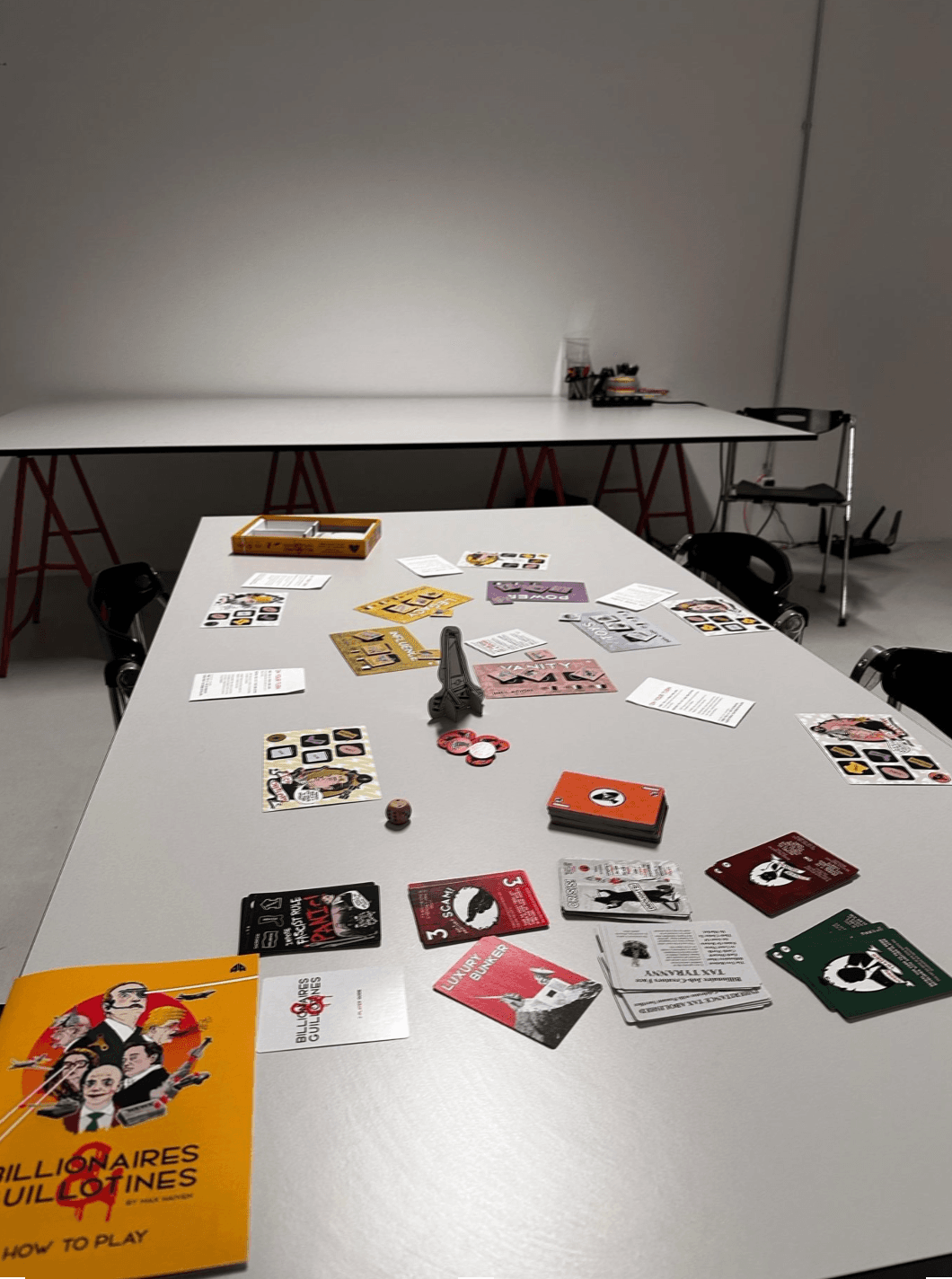
The game offers a learning experience of the unforgiving logic of today’s neoliberal extractivist practices. The billionaires fight each other savagely, but, if they are threatened by external forces, they may opt for a temporary truce and collaborate against their common enemy (which basically means the rest of us) by launching an imperial war, enforcing repression, resorting to fascism, or, more mildly, agreeing to share some scraps of their endless wealth in order to contain dissent.
The potential of games as a learning tool is also highlighted by another well-known designer of so-called ‘serious’ games, Brenda Romero. In a TED talk in 2011, she said that “games change how we see topics, change our perceptions about those people in topics, and change ourselves, because we’re involved and we are playing, and we’re learning as we do so”.
Romero, a US citizen of Irish descent, coined the motto “the Mechanic is the Message”. The idea is well exemplified in her board game Síochán leat (2009), which involves a mise en scène of the Cromwellian invasion of Ireland. Since the players play the Irish, they cannot win: they are already defeated. A successful game basically means saving as many people as possible while the enemy pieces (the Cromwellian army) confine them to ever smaller areas, depriving them of land. When the game ends and the table is full of ‘Irish’ tokens that have been sacrificed or crowded into shrinking spaces, players’ minds go immediately to the families deported, divided, or deprived of their lands by the invasion.
Haiven and Romero are only two of the many designers using traditional mechanics in board games to raise awareness.
Thanks to the spread of online crowdfunding, today it is much easier to produce games offering perspectives that don’t find space in the larger industry. That’s how board games such as Spirit Island (2017), a cooperative board game where players have to defend their island against colonialist settlers trying to occupy it, or Le Barricate (2022), recounting the (little-known) episode of resistance by the Italian town of Parma against Fascist militias in 1922, could be produced and distributed.
Critical designers emerged in the video game industry as well. Postcolonial authors such as Muriel Tramis, Elizabeth LaPensée, Meg Jayanth, and Naphtali Faulkner — to mention just a few of the most relevant — have produced several products that rewrite histories from anti-hegemonic perspectives and give voice to marginalized and indigenous peoples.
In recent years, various designers have also emerged in the Arab world, often focusing on the Palestinian issue, with titles like Liyla and the Shadows of War (2016), where the player assumes the role of a young girl trying to survive bombs and drones in Gaza, or Under Ash (2001), set during the First Intifada.
And if all these cases still represent a niche, the trend appears to be spilling over into the mainstream industry. One episode of a blockbuster action video game series, Assassin’s Creed: Freedom Cry (2013), is set in the slave colony of Saint-Domingue; the player impersonates a former slave taking action against the colonial occupiers, in what would become the liberation of Haiti. More recently, Isaac Childres, the author of Gloomhaven (2017), one of the most successful board games ever created, designed its sequel, Frosthaven (2022), through a critical revisitation of how to approach the different races inhabiting the game’s fantasy world, in order to avoid stereotypes and racist tropes.
All these cases show that games are a crucial battleground for countering far-right views and reactionary historical narratives. Anti-fascist and anti-colonialist cultural strategies need their own alternative worlds and forms of play that speak to the anxieties of our societies. Games are far too serious a matter to be left only to profit-oriented business, let alone fascists. And they deserve more attention and investment from all of us.