
Gamed Capitalism and the New Forms of Fascism: A Conversation with Max Haiven
InterviewCapitalism tells each of us to be a player: to speculate, invest and seize our chances. Yet most of us know the game is rigged. In this conversation, Max Haiven explains how 21st-century fascism feeds on the anger of the “cheated player”, why far-right violence increasingly takes gamified forms, and what games might offer anti-fascist struggles.
Bio
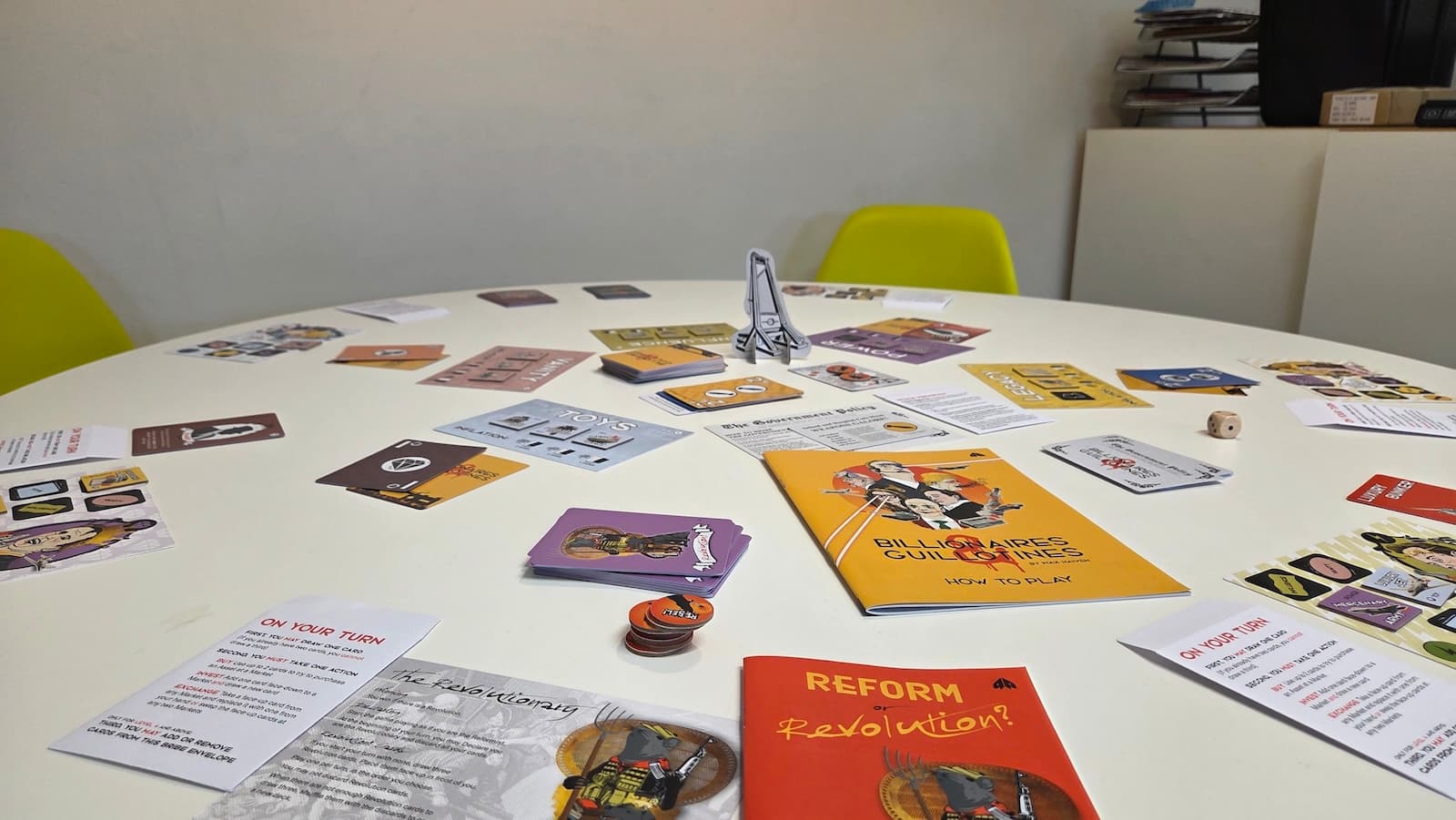
Max Haiven is a writer, game designer, and educator and the Canada Research Chair in the Radical Imagination at Lakehead University. His board game Billionaires & Guillotines is published by Pluto Press and his latest book, The Player and the Played: From Gamed Capitalism to 21st Century Fascism, is published by MIT. He has written many books and articles and created podcasts on themes including art, finance, imagination, globalization, conspiracies, fascism, and grassroots activism.
In this conversation, we discuss some aspects of his latest book, The Player and the Played: From Gamed Capitalism to 21st-Century Fascism (MIT Press, 2026). The book can be downloaded for free here. This interview is a cooperation with Untold Magazine.
Interview
Börries Nehe: Your book is not about games themselves, as you state in the introduction. Rather, you maintain that games are a way to better grasp the nature of contemporary capitalism, what you call “gamed capitalism”. What do you mean by this, and what do you see when looking at today’s capitalism through the lens of games?
Max Haiven: This book is an extension of a longer set of inquiries into the financialisation of the capitalist economy. It’s part of an attempt to grapple with how financialisation depends on each social subject reconfiguring themselves for a new form of participation within the capitalist economy.
Capitalism, predominantly but not exclusively in the global North, has reoriented itself towards needing people to consume, to invest, to go into debt and to become pioneers of their own colonisation of the lifeworld in the interests of capitalist accumulation.
I think the form of capitalism we’re living under right now is not content just to conscript our bodies and time.
It also needs to conscript our agency. It needs to hail each of us as active, creative, speculative individuals, and offer us at least the promise of rewards for investing our time and energies in the name of our own personal survival or profit.
For an investigation of that form of capitalism, thinking through games is especially useful, because games depend fundamentally on agency. A game is not a game unless it gives you some degree of agency, in the sense that what defines a game is that the outcome depends on the participants and the choices they make.
But the other side of games is that they offer us a highly constrained form of agency. With the exception of open-world games or tabletop role-playing games, where you can really let your imagination run wild, most games give you a very limited palette of choices.
In this moment of capitalism, we’re all encouraged to be players, whether it’s speculating on housing, on education, on relationships, on prediction markets or on crypto.
But our actual range of action is extremely limited. And, perhaps most importantly, the house always wins. I think this is indicative of something much broader: though we’re always encouraged to be players, we also know that the game is rigged and most of us are going to lose.
Enrico De Angelis: You maintain that fascist politics, in both the 20th and the 21st centuries, emerges structurally from the contradictions of capitalism. In fact, it is embedded in it, as an “asphyxiating allergic reaction” to conditions that capitalism itself creates. What are the distinctive elements that give today’s fascism its particular forms?
MH: Fascism emerges when capitalism is in crisis and a political formation arises that promises to use extreme revolutionary violence to solve capitalism’s contradictions and crises for it. So, on the one hand, fascism is a particular pathology of the ruling class that is produced endogenously within capitalism. On the other hand, we have to contend with fascism as a set of political ideologies and affects that are not very appealing to the ruling class, but present themselves as a false rebellion.
On the level of affect and ideology, fascism now finds fertile ground in which to plant itself and grow: the disposition of what I call the “cheated player”. Financialised capitalism has insisted that we all become players, investing our scarce assets in a kind of warlike competition for scarce resources. If we all know we’re playing to lose and the game is rigged, then we all feel cheated. And it’s that feeling of being cheated that 21st-century fascism is so adept at seizing upon.
Each form of fascism is historically contingent. It emerges out of the form of capitalism that incubated it, and it bears many of that capitalism’s hallmarks. While 20th-century fascism was highly nationalist, militaristic and hierarchical, 21st-century fascism emerges from a capitalism that is much more individualised. People are not told to be an obedient part of the nation and go and do their jobs. Rather, they are told: “You are a ruthless entrepreneur in a battle for survival against everyone else.” 21st-century fascism picks up on those sentiments. It also reflects a form of capitalism that is much more invested in transforming everyone into the illusory figure of the financier, the speculator, the entrepreneur.
And it offers people a lot of opportunities to become that figure. Those opportunities often present themselves as very playful, very creative and agent-driven. Maybe a quick way of saying it is that 20th-century fascism was the fascism of the radio broadcast and the industrial steelworks, and 21st-century fascism is the fascism of YouTube and Uber.
EDA: Networked, leaderless mobilisation once seemed to be the left’s terrain, from Occupy to the Arab uprisings. Why is the far right now so much better at it?
MH: We are always at a disadvantage relative to the far right, because what the left is asking for is a total transformation of social institutions and social subjects. Capitalism is always inclined towards fascism because its fundamental operating system echoes a fascist ideology: “Power is all that is, was and will be. Competition is natural. There are those who recognise this and take power for themselves, and those who are too stupid to recognise it.”
If capitalism could speak, that’s what it would say. And so the far right can simply say: “Well, that’s obviously what’s happening already, so why don’t we just make it our political reality?” They don’t need to ask people to fundamentally change who they are.
Instead, they’re interested in destroying what few protections we’ve managed to build into society to protect it from capitalism. Their enemy isn’t the system or the kind of people the system creates.
Their enemies are liberals and leftists within the system who are preventing capitalism from becoming a completely fascist formation. And the far right has a certain ease, an ease that is especially pronounced at a moment when, thanks to the affordances of digital technologies, we can each become entrepreneurial in a political sense.
Today, you have a million different entrepreneurs all trying to produce content to gain market share, swarming together towards the production of fascist ideology.
If you have a house with an extra room, put that room on Airbnb. If you have an extra four hours in the day, get in your car and become an Uber driver. If you happen to have a pretty face and a way with words, get yourself on TikTok or Instagram and see if you can become an influencer. We’re told to embrace this entrepreneurial spirit in every aspect of our lives, and 21st-century fascism has embraced it too. Its key architects are very aware that this is what people want. It makes people feel powerful, like agents, like they’re useful, like they’re part of something greater than themselves, like they’re valued. I think that is a big part of its appeal.
EDA: In the book, you argue that some people are allowed to cheat, while others are punished for it. What mechanisms are at work here? Who is allowed to cheat, and who isn’t?
MH: 21st-century fascism has been extremely successful in mobilising people’s political anger around the idea that they are being cheated. But it misdirects their feeling of being cheated towards various vulnerable others, what I call the “cheating other”. Migrants are said to be cheating the border. Welfare claimants are said to be cheating society of its wealth. Environmentalists and leftists are cheating society of its prosperity and productivity. Trans people are allegedly cheating in sport.
At the same time, politicians have emerged all around the world who take pride in being conspicuous cheats. Donald Trump is only the most egregious and transparent example, but he’s the template on which much of this is built. Think of the Bolsonaro family in Brazil, or Modi’s completely corrupt regime in India. All around the world, far-right political parties engage in constant corruption and cheating. And yet these prestigious cheats of the far right are somehow able to turn their conspicuous and transparent cheating into a virtue.
Fascism can publicly sustain massive contradictions, and one of the arguments in the book is that sustaining these transparent contradictions is a feature, not a bug, of fascism. What it says to followers is not “these people are hypocrites”, but rather “these people are so powerful that they can bend reality, that they can be corrupt and cheat in plain sight and get away with it”. That, fundamentally, is the ontology of fascism: might makes right.
The vast majority of us already know we’re being cheated by the system, and that the only way to win is to cheat a little. We also know that almost everyone in a position of power is cheating in some way. So why not vote for the transparent cheat who at least has the decency to tell you he’s cheating, who isn’t going to try to hide it and claim the moral high ground?
BN: You describe the “playgrom” as a 21st-century form of fascist mob violence. Is this the shape fascist militias take today – organised play rather than organised paramilitaries? And what does that tell us about fascist violence now?
MH: The term “playgrom”, which I introduce in the book, is a portmanteau of “play”and “pogrom”. It offers a framework for understanding fascist mass violence in the 21st century.
Pogroms and other forms of far-right mass violence have always been fun for the perpetrators. The historical record is clear. Whether in Russia, Poland or Germany, or with settlers carrying out pogroms in the occupied West Bank or Hindus carrying out anti-Muslim pogroms in India, there is always an element of violent jouissance. There’s the joy that comes from wielding dehumanising power over another. And there’s also the joy that comes when a subject knows they’re doing something that violates what they would otherwise imagine to be their values. If you’re not usually a person who goes out and lynches people, when you do it with a group, you make fun of it as a way to alleviate the contradiction within you and to build a kind of esprit de corps.
This playful aspect of mass violence has taken on a particular form under 21st-century capitalism and its ascendant forms of fascism.
One aspect has to do with gamification itself: the way we are trained and habituated, through the games we play, to undertake violence and create human disposability. In a first-person shooter, you might murder 300 people in two hours of play. In a 4X strategy game, you wipe out whole civilisations. We know that there’s no direct link between violence in video games and violence in real life. But something is going on at the level of culture with this dehumanisation. We see it in Israel’s genocide in Gaza. We saw it in the war on terror prosecuted by the United States and its allies. Whole populations in the Middle East were deemed unworthy of life because they were seen as enslaved to some sort of doctrinaire programme, whether political Islam or obedience to Saddam Hussein. They were therefore treated as not fully human, and as people who could be murdered.
Today, this is echoed and repeated among young men who play a lot of violent video games. More broadly, many of today’s forms of mass violence are taking place through online platforms and taking gamified form.
In the book, I focus on two examples. One is the Gamergate saga of about a decade ago. Almost exclusively male gaming enthusiasts assembled into a massive leaderless swarm. They were driven by a conspiracy theory that feminist game makers and game critics were sleeping their way to the top of the games industry and undermining its meritocracy. They committed horrible acts of harassment and persecution, using techniques developed for playing multiplayer online games together, such as message boards, leaderboards, rankings and other forms of collective feedback.
The other example is the Christchurch massacre in New Zealand. A white supremacist terrorist murdered 52 people at an Islamic community centre and a mosque, and filmed and broadcast his massacre as if it were a first-person shooter. He drew on the vernacular of games and their broader culture, and modified his weapons as if he were in a video game. His audience of mostly far-right gamers cheered him on and awarded him points for his kills, as if he were live-streaming himself playing a video game.
EDA/BN: Does this mean the “playgrom” has more to do with video games in a strict sense than with the gamified, financial capitalism we discussed earlier?
MH: My argument is that these playgroms are ultimately doing the work of fascism. One of the questions that plagues contemporary students of fascism is this. If this (Trump, Modi, the AfD) is fascism, then where are all the things we would expect from 20th-century fascism? Where, for instance, are the paramilitary squads that do the work of fascism before it takes state power? One response might be that those squads are no longer military-style, hierarchical units like the squadristi in Italy or the SA in Germany. Today they take the form of amorphous, swarm-like, playful formations. In the case of Gamergate, they assemble to do the work of fascism. In the case of the Christchurch massacre, they have a stochastic iterability: they just pop up here and there.
So ultimately this form of playful mass violence works for fascism and for capitalism alike. It terrorises racialised people, women and trans people, and in doing so it lowers the cost of their labour and creates divisions within the working class. This is the work that deputised violence has always done under capitalism. But it is also doing the work of fascism, because it is building fascist infrastructure here and now.
BN: In this context, what is the relationship between games and anti-fascism? You are also a game designer: you created Billionaires & Guillotines. So the question really is: what is an anti-fascist game, or what is the game of anti-fascism? And what can we learn from what games have to offer?
MH: We live in gamed capitalism, and at least a billion human beings play a commercial game every day. Anti-fascists cannot afford to ignore games. The left has a certain scepticism or elitism towards games, which I think is at best foolish and at worst actually suicidal.
There are plenty of games that lay claim to being part of an anti-fascist project. The most famous is perhaps Wolfenstein 3D (1992), one of the original first-person shooters. You play as a Polish-American super soldier who escapes from a Nazi dungeon, steals the guards’ weapons and kills his way to a final battle against a cyborg Hitler. There are other games as well. In Through the Darkest of Times (2020) by the Berlin-based studio Paintbucket Games, you play an anti-fascist terrorist cell in Berlin between 1933 and 1945. Another example is Antifa: Le Jeu (2021) by the French collective La Horde. All of these games explicitly lay claim to an anti-fascist legacy, and I think they have a lot to offer us.
At the same time, a truly anti-fascist game would need to engage fascism on three levels at once. The first level is obvious: we need to confront explicit fascist ideology and avowed fascists, as well as implicit fascist ideology and implicit fascists. We need games that show us the value of fighting back against the far right and doing the work of anti-fascism, like the games I’ve just mentioned.
There’s a second level of anti-fascist thinking that needs to be involved as well: recognising that, under capitalism, fascism has always been here. It just hasn’t been evenly distributed. Since the defeat of the fascist regimes in 1945, the so-called West has supported many fascist dictatorships around the world. Similarly, fascism has always been here in the sense that the police, prisons, borders and other authoritarian capitalist institutions that enforce racial rule have always been part of the system. An anti-fascist project, and the anti-fascist game more broadly, needs to address how fascism is already institutionalised within liberal capitalist democracies.
Third and finally, an anti-fascist project has to take into account what is sometimes called micro-fascism: the way each and every one of us already carries the seeds of fascism within us. Our authoritarian tendencies, our patriarchal tendencies, our yearning for power and our wish for simple answers to the complexities of life: these are all things that fascism grips onto. An anti-fascist project also needs to include a confrontation with micro-fascism.
And a final point I would like to conclude with: we need to think a lot more about agency. In anti-fascist struggles we think a lot about ideology and about narratives. But one of the things 21st-century fascism has latched onto is the way gamed capitalism encourages us to be players, to maximise our agency, to seize our opportunities.
As human beings, we are very attached to our sense of agency.
One of the problems with anti-fascist organising is that we often don’t think enough about how our movements can be spaces where people feel a sense of agency. We need to offer forms of agency that are collective, where we feel powerful together, and where we feel the power to create a world rather than power over other people. That is one of the things games can really offer an anti-fascist project: an opportunity to practise working together, living together, being together, being in relation, and mixing together in different ways.
